
Commercial polishing, answered
Polishing FAQ
250 straight answers on commercial and industrial concrete polishing, across 15 topics. Don’t see yours? Call (724) 814-1745.
250 answers in the library
Mechanically polished concrete is the actual slab itself, ground progressively finer with diamond tooling until the surface reaches a chosen sheen level. There is no coating, paint, or overlay sitting on top, so there is nothing to peel, chip, or delaminate. The result is a permanent surface that is part of the structure itself. Call (724) 814-1745 and we will walk you through exactly how the process would work on your Pittsburgh facility.
A densifier is a liquid silicate compound that reacts chemically with the calcium in the concrete, filling microscopic pores and forming a harder, denser matrix throughout the slab. This step strengthens the surface so it can hold a higher polish and resists dusting under heavy traffic. Without it, the grind-and-polish process alone would leave a softer, more porous result. If you want to understand the full process before committing, request a free quote at (724) 814-1745 and we will explain every step.
A penetrating guard or topical sealer is commonly applied after polishing to improve stain resistance and reduce the effect of spills on porous areas. The guard soaks into the surface rather than sitting on top, so it does not alter the look or create a film that can wear unevenly. In food-service and industrial environments it is typically recommended as a safeguard against oils, chemicals, and cleaning agents. Talk to our team at (724) 814-1745 to find out which guard level makes sense for your specific use.
Diamond tooling typically progresses through coarse, medium, fine, and very fine grits, and the final sheen is determined by how far the process is taken. Common finish levels range from a matte or satin look at lower grits to a semi-gloss, high-gloss, or near-mirror finish at the finest levels. The right stopping point depends on the use case, traffic type, and aesthetic goal for the space. Call (724) 814-1745 and describe your facility so we can recommend the finish level that fits.
Most slabs in good structural condition qualify, but the surface needs to be assessed for cracks, contamination, previous coatings, moisture issues, and overall flatness before committing to a finish level. Heavily contaminated or badly damaged slabs may require repairs or prep work first, and some areas may need patching compounds that could show through the finished surface. A site visit is the only reliable way to know what your Pittsburgh facility floor can support. Schedule a free on-site assessment by calling (724) 814-1745.
The amount removed depends on the starting condition of the floor and the aggregate exposure level chosen, but polishing is a surface-level process that removes far less than a typical milling or scarifying operation. For a cream-finish polish, removal is minimal, essentially just opening the top layer. For full aggregate exposure, the grind goes deeper but is still measured in small fractions of an inch. We assess every floor individually before quoting so you know what to expect. Call (724) 814-1745 for a free evaluation.
The difference is how deep the initial grind cuts into the slab before polishing begins. A cream finish stays near the very top, showing the fine paste layer with minimal aggregate visible. Salt-and-pepper exposes some of the fine aggregate and gives a speckled appearance. Full aggregate exposure cuts deep enough to reveal the larger stones throughout the mix, which is often chosen for a dramatic decorative effect. Each has different labor and time requirements, and our team can show you samples. Call (724) 814-1745 to discuss which look fits your Pittsburgh facility.
Polished and densified concrete is commonly chosen for warehouse and distribution environments precisely because it performs well under repeated forklift and pallet jack traffic. The densification step hardens the surface, reducing dusting and the surface degradation that untreated concrete experiences over time. Proper joint maintenance and any necessary crack repairs before polishing are important for long-term performance under heavy loads. If you manage a warehouse or distribution center in the Pittsburgh area, call (724) 814-1745 and let us assess your floor.
Polished concrete can be specified at varying sheen levels, and lower-sheen finishes combined with a penetrating guard typically meet common commercial slip-resistance standards. Higher-gloss finishes in wet or greasy environments often require an anti-slip additive in the guard coat. Compliance with OSHA and local safety codes for your specific use is something we factor into the recommendation. Call (724) 814-1745 so we can match the finish spec to your safety requirements.
Production rates vary based on the condition of the slab, the finish level chosen, and the equipment used, but large commercial and industrial floors are often completed in phases to minimize business disruption. Many facilities coordinate polishing during off-hours, weekends, or phased shutdowns of sections. We provide a realistic timeline as part of every quote based on your actual square footage and schedule constraints. Call (724) 814-1745 to start planning the scope and schedule for your Pittsburgh facility.
It can be done in many cases, but the existing coating must be fully removed first, which adds grinding time and can affect how the finished surface looks depending on what the coating left behind. Bond-failed or contaminated areas may require patching before polishing, and in some situations the original coating chemistry can slow the densifier reaction if not fully removed. A pre-project assessment is essential in these cases. Call (724) 814-1745 and describe your current floor so we can quote the prep work accurately.
Polished concrete is widely used in commercial settings partly because maintenance is straightforward: dry dust mopping or auto-scrubbing with a neutral-pH cleaner on a regular schedule is typically all that is needed. Acidic or solvent-based cleaners should be avoided because they can etch the surface or degrade the guard coat over time. Periodic reapplication of the surface guard, depending on traffic intensity, keeps the floor performing at its best. For a maintenance plan written for your operation, call (724) 814-1745 and ask about our post-install care recommendations.
Polished concrete that was properly prepped, densified, and maintained is widely regarded as one of the most durable commercial floor surfaces available, with service life commonly measured in decades rather than years. The performance depends on traffic type, maintenance consistency, and whether the guard coat is refreshed when needed. Unlike coatings that have a fixed film life, the polished slab itself does not have an expiration date. To understand what realistic longevity looks like for your specific use, call (724) 814-1745 for a free consultation.
Concrete naturally expands and contracts with temperature, and polished concrete handles this the same way any concrete floor does, as it is the slab itself rather than a separate material. Moisture mitigation is an important pre-project step, because active vapor transmission can affect how the densifier cures and how the guard performs over time. We test for moisture as part of every assessment in the Pittsburgh area. Call (724) 814-1745 to schedule an evaluation and find out if your slab is ready for polishing.
We install both polished concrete and epoxy, so our recommendation is based on what actually fits your facility rather than a preference for one system. Polished concrete is the slab itself and has no coating that can delaminate, while epoxy provides a colored, chemical-resistant membrane that bonds to the slab. The right choice depends on chemical exposure, aesthetics, budget, and how much downtime you can allow. Call (724) 814-1745 and we will walk through both options for your Pittsburgh location and give you an honest comparison.
Yes, crack and joint repairs are a standard part of the prep phase on most commercial and industrial polishing projects. Cracks are typically filled with semi-rigid or rigid epoxy or polyurea filler, and the choice of filler affects how visible the repair is in the finished surface. Control joints are usually honored and cleaned up rather than filled, though decorative routing or banding can be used to integrate them into the design. Tell us about your floor condition when you call (724) 814-1745 and we will quote the prep work along with the polish.
High-gloss polished concrete is notably reflective and in many warehouse and plant environments it reduces the number of fixtures or the wattage required to achieve target foot-candle levels. This is a frequently cited operational benefit in large facilities with high ceiling-mounted lighting. The effect is most significant at semi-gloss and above, though even a satin finish adds meaningful ambient light compared to an unfinished concrete floor. To see how this could benefit your Pittsburgh facility, call (724) 814-1745 for a free assessment.
A penetrating guard absorbs into the concrete matrix and does not form a film on the surface, so the texture and sheen of the polish are unchanged and there is no film to wear through. A topical sealer sits on top of the surface, which can add additional gloss and chemical protection but creates a coating layer that can eventually wear, scuff, or require stripping. Most commercial facilities benefit from a penetrating guard as the primary protection, sometimes combined with a light topical coat for high-gloss areas. Our team will recommend the right system for your use case when you call (724) 814-1745.
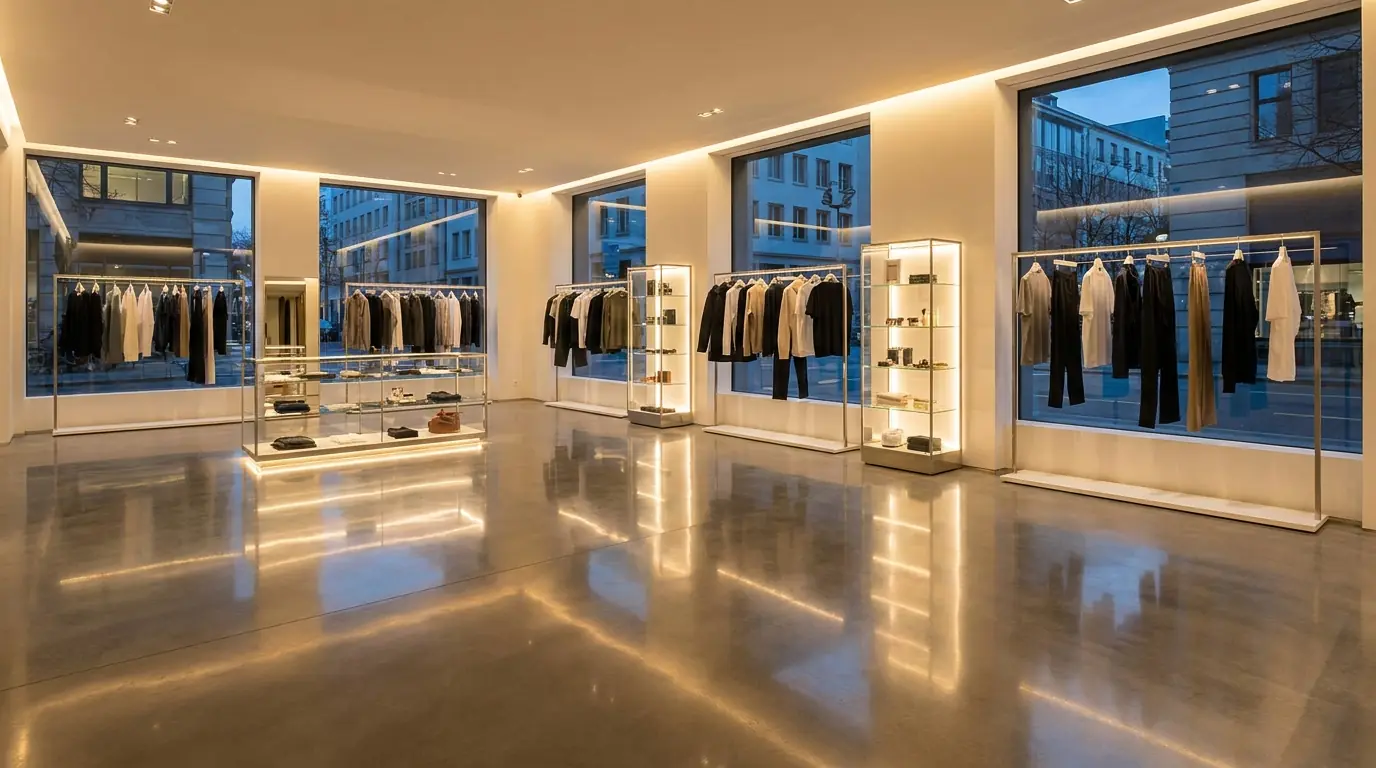
Polished concrete delivers a clean, high-end look that scales easily from small boutique retail to large-format showrooms without the seams, grout lines, or replacement cycles of tile or resilient flooring. The reflective surface naturally enhances merchandise lighting and gives a contemporary feel that holds up to constant foot traffic without looking worn. Maintenance is simple, which matters in retail environments where floor care cannot disrupt store hours. To see what polished concrete would look like in your Pittsburgh retail or showroom space, call (724) 814-1745 for a free on-site quote.
Polished concrete paired with the right penetrating guard and, in wet or greasy zones, an anti-slip additive is used in many commercial food-service kitchens because it is easy to clean, does not harbor bacteria in seams or grout lines, and holds up to frequent wet mopping and commercial cleaning equipment. The surface must be properly sealed and maintained to prevent oil and food acid penetration, and joint repairs are important to eliminate moisture traps. We install both polished concrete and epoxy and can recommend the right system for each zone in your kitchen. Call (724) 814-1745 to discuss your restaurant or food-service facility.
Polished concrete is widely used in front-of-house dining, taprooms, and brewery tasting rooms because the industrial aesthetic fits the design language of those spaces and the surface handles chair scuffing, spilled beverages, and high-heel traffic with minimal visible wear. A properly guarded finish resists the light staining from food and drink that a dining floor inevitably encounters. The surface can also incorporate dyes or decorative scoring to match the brand identity of the space. Call (724) 814-1745 to discuss the right finish level and stain protection for your restaurant or brewery floor.
Polished and guarded concrete is used in many medical and clinical environments because the continuous surface eliminates the grout lines and seams where bacteria and moisture accumulate. Proper guard selection is important for compatibility with the disinfectants used in healthcare settings, as some aggressive chemicals can affect certain sealer chemistries. We specify guard products appropriate for medical-grade cleaning protocols. To find out if polished concrete is the right fit for your clinic or medical facility in Pittsburgh, call (724) 814-1745 for a free consultation.
Polished concrete is used in many gym and fitness environments, particularly in weightlifting, CrossFit, and functional training areas, because it is durable, easy to mop, and does not trap sweat or bacteria the way rubber tile seams can. Rubber flooring is often laid over polished concrete in impact zones, which means the polish serves as the sub-floor surface in equipment areas and the visible floor in common corridors and locker room approaches. Satin to semi-gloss finishes are typical in these settings to balance aesthetics and slip resistance. Call (724) 814-1745 to plan the right flooring system for your Pittsburgh fitness facility.
Corporate offices frequently choose polished concrete for lobbies, open work areas, and corridors because it projects a clean, modern aesthetic that is consistent with contemporary workplace design. The surface is easy to maintain without the chemical stripping and waxing cycle that vinyl composition tile requires, and it does not trap allergens the way carpet does. Dye options and decorative banding allow the floor to incorporate brand colors or wayfinding elements. To explore what polished concrete could look like in your Pittsburgh office project, call (724) 814-1745.
Grocery and large-format retail environments benefit from polished concrete because the surface handles cart traffic, pallet jacks, and spills while remaining easy to clean with auto-scrubbers. The reflective quality improves ambient lighting, which matters for produce and merchandise presentation. There are no wax or finish coats to strip and reapply on a seasonal schedule, which reduces labor and chemical costs. For a free assessment of your Pittsburgh grocery or retail warehouse floor, call (724) 814-1745.
Polished concrete is commonly specified in hospitality environments because a high-gloss finish creates a refined look comparable to large-format stone tile at a lower total cost over the life of the floor. The continuous surface eliminates grout maintenance and handles rolling luggage, event furniture, and high-heel traffic well. Decorative elements like dye, aggregate exposure, and scoring allow the floor to be customized to match the venue's design intent. To discuss polished concrete for your Pittsburgh hotel, event venue, or hospitality project, call (724) 814-1745.
Auto dealership showrooms are one of the most common applications for polished concrete because the surface handles vehicle weight, tire scuffing, and spilled fluids while providing the upscale, reflective look that complements new vehicle presentation. The service drive is a different environment that typically benefits from a more chemically resistant epoxy or urethane coating, and we can specify the right system for each zone. Service bays with oil and chemical exposure are often better served with a different coating system, which is a distinction we make honestly as a company that installs both. Call (724) 814-1745 to talk through the right specification for your dealership.
Distribution and fulfillment centers are among the strongest use cases for polished concrete because the densified surface resists dusting, handles repetitive wheeled traffic, and reduces tire marking compared to some coating systems. The improved light reflectivity also supports pick accuracy in high-rack environments. Many facilities phase the work to keep operations running during installation. Call (724) 814-1745 and tell us your square footage and operational constraints so we can quote your Pittsburgh distribution center project.
Institutional corridors, cafeterias, and common areas in schools and universities are common applications for polished concrete because the surface is durable enough to handle student foot traffic and rolling equipment while being significantly easier to maintain than waxed VCT tile. School budgets benefit from the reduction in floor-care chemical and labor costs over the long term. Slip resistance at the specified finish level should be confirmed for each area, especially near exterior entry points. To discuss a polished concrete project for your Pittsburgh educational facility, call (724) 814-1745 for a free quote.
In prep and dish areas, polished concrete requires a higher level of slip-resistance additive in the guard and careful attention to drainage slopes, because these zones are persistently wet and greasy. Many commercial kitchens use polished concrete in prep areas where appropriate anti-slip treatment and drainage are in place, and our team is experienced in specifying the right combination for each zone. Dining floors typically allow a higher sheen because they are not as consistently wet. We install both polished concrete and epoxy and will recommend the right system for each zone in your Pittsburgh kitchen. Call (724) 814-1745 for a free evaluation.
Craft beverage production spaces benefit from polished concrete because the densified surface resists the mild acids found in beer, wine, and kombucha, holds up to keg rolling and forklift traffic, and is easy to hose down and scrub. The aesthetic also fits the exposed-industrial design language common in brewery taprooms and production floors. Drain placement and surface slope are important considerations in production areas, and we factor these into the pre-project assessment. Call (724) 814-1745 to discuss your Pittsburgh brewery or production floor project.
Polished concrete is compatible with neutral-pH commercial cleaners, which are the standard recommendation for daily maintenance. Harsh acidic or highly alkaline cleaners can etch the surface or degrade the guard coat, so product selection matters in daily-mop environments. We provide cleaning and maintenance guidelines as part of every commercial installation to protect the floor's appearance and performance. For a free quote on polished concrete for your Pittsburgh commercial space, call (724) 814-1745.
GCs typically specify polished concrete as a finish-trade item after the slab is poured, finished, and cured to an appropriate point. Early coordination on slab mix design, finish type, and joint placement can simplify the polishing scope and improve the final result. We work directly with GCs on TI and new construction projects and provide specifications, scope letters, and scheduling coordination. If you are a Pittsburgh-area general contractor, call (724) 814-1745 to discuss subcontractor pricing and spec support for your project.
Polished and properly guarded concrete is used in many veterinary and animal care facilities because it has no seams or grout lines that trap animal waste and bacteria, and it cleans up quickly with the disinfectants common in those environments. Guard product selection must be vetted for compatibility with enzymatic cleaners and disinfectants used in animal care settings. Slip resistance is an important spec consideration for animal handling areas. To find out if polished concrete is the right choice for your Pittsburgh pet care or veterinary facility, call (724) 814-1745.
Polished concrete handles routine forklift and pallet-jack traffic well in distribution environments, provided the underlying slab is sound and the correct grit level is achieved. The densified surface resists surface abrasion from hard and cushion-tire forklifts better than many unfinished slabs. We assess your traffic patterns and load cycles before recommending a polish level. Call (724) 814-1745 or request a free site quote within 24 hours to find out what spec fits your operation.
A properly densified and polished slab distributes point loads similarly to any finished concrete floor, and the denser surface layer can reduce micro-cracking from static rack legs over time. We evaluate your rack layout and existing slab thickness before committing to a spec. For facilities with unusually heavy concentrated loads, we often recommend pairing polish with a targeted joint-fill program. Reach out at (724) 814-1745 and we will assess your plant floor at no charge.
Dust generation from bare concrete is one of the most common reasons commercial facilities in the Pittsburgh area choose polished concrete. The densifier reacts with free lime in the slab and the polishing process closes surface porosity, dramatically reducing the fine particulate that unfinished slabs shed. Cleaner floors also mean less contamination of conveyor equipment, racking, and inventory. Call us at (724) 814-1745 and ask about our dust-control consultation at no cost.
Polished concrete is commonly installed in food and beverage facilities because the densified surface is easy to wash down and does not harbor the micro-pores that unfinished concrete does. A guard or sealer layer can be specified to handle the cleaning chemistry your operation uses. We verify that the slab moisture and drainage conditions are compatible before recommending a finish level. Call (724) 814-1745 to schedule a no-cost walkthrough of your production floor.
A higher-grit salt-and-pepper or cream finish reflects ambient light meaningfully in large warehouse bays, which many facility managers report reduces perceived lighting costs or allows fixture spacing adjustments. The right sheen depends on your ceiling height, fixture type, and safety requirements. We can provide sample boards and reference sites so you can judge the reflectance in person before committing. Call (724) 814-1745 and we will get you a free quote with sheen options laid out clearly.
Cold storage environments present specific challenges, including moisture migration through the slab and thermal cycling that stresses surface treatments. Polished concrete is often a good fit because it does not trap moisture the way coating systems can, reducing the risk of delamination in freeze-thaw cycles. We evaluate the vapor profile and slab condition of your cold storage space before specifying a finish. Contact us at (724) 814-1745 or request a free 24-hour quote tailored to refrigerated environments.
Polished concrete is widely used in automotive and fleet service shops because it resists tire marks from rubber compounds, is easy to clean after oil and fluid spills, and holds up to vehicle traffic without the peeling risk associated with thin coatings. A guard layer can be added for additional chemical resistance where heavy solvent use occurs. We install both polished concrete and epoxy coatings, and we will walk you through which makes the most sense for your shop layout. Call (724) 814-1745 for a free shop-floor assessment.
Steel-wheel traffic is harder on any floor than rubber-tired equipment, and we factor that into grit selection and densifier dwell when specifying polished concrete for metals industry facilities. Higher-hardness slabs tend to polish well and resist steel-wheel wear better than softer concrete. In some cases a hardener top-coat is appropriate. Tell us about your equipment and we will give you an honest read, call (724) 814-1745 for a free site visit.
Traffic markings and safety zones are commonly applied over polished concrete using two-component polyurethane or epoxy-based paints that bond well to a properly prepared polished surface. The cleaner, denser surface often holds striping longer than raw concrete because there is less outgassing and contamination to interfere with adhesion. We coordinate striping as part of our project scope or work with your striping contractor. Call (724) 814-1745 and we will include a striping plan in your free quote.
Construction joints and saw-cut control joints are filled and stabilized before polishing so that the grinding heads do not catch edges and chip the joint faces. We use semi-rigid or rigid fillers depending on whether the joint still has movement. Large slab plates with curling or differential settlement get assessed for grinding feasibility before we commit. Request a free consultation at (724) 814-1745 and we will walk your joints with you.
Large-footprint industrial projects are phased so that portions of your facility remain operational while we work. We use ride-on planetary grinders for the field and walk-behind machines for the perimeter, and we schedule concrete densifier curing time into the phasing plan. Our project managers coordinate with your operations team to minimize downtime. Call (724) 814-1745 and we will outline a phased project schedule as part of your free quote.
Data center and server room environments benefit from polished concrete because the densified surface generates virtually no particulate, unlike bare or insufficiently finished concrete that sheds fine dust into air-handling systems. The low-maintenance surface is also compatible with anti-static guard treatments used in static-sensitive environments. We evaluate your slab condition and any existing raised-floor or underfloor air systems before starting. Contact us at (724) 814-1745 to discuss your data center's flooring requirements at no cost.
Polishing under existing racking and mezzanine structures requires specialized tooling and careful coordination to avoid rack damage, but it is commonly done in phased projects where sections are cleared row by row. We account for the tighter equipment access in our scheduling and pricing. Post-polish guard application works the same way in tight spaces with smaller applicators. Call (724) 814-1745 and we will walk the space with your operations team to plan access before we quote.
Both polished concrete and epoxy systems are used in pharmaceutical and clean-manufacturing environments, and each has genuine strengths. Polished concrete offers a continuous surface without a coating layer that can chip or delaminate, while certain epoxy systems provide specific chemical resistance profiles or ESD properties that polished concrete cannot match alone. We install both and will recommend the right system based on your contamination control requirements. Reach out at (724) 814-1745 for a complimentary consultation specific to your facility.
Preparation typically includes removing existing coatings or adhesives, patching spalls and voids, stabilizing active cracks, and filling control joints before the grinding sequence begins. The condition of your slab determines how many coarse grinding passes are needed before we transition to refining grits. Skipping or rushing preparation is the most common cause of a polished floor that does not perform as expected. Call (724) 814-1745 and we will do a full slab assessment as part of your free quote.
Polished concrete with a penetrating guard or topical sealer is used in printing and packaging facilities where occasional chemical exposure is a reality. The key is specifying the right guard chemistry for the solvents and inks your plant uses, since not all guards offer equal resistance. We verify compatibility with your cleaning chemicals before recommending a finish. Call us at (724) 814-1745 and we will build a spec around your plant's actual chemical exposure.
Most polished concrete projects allow light foot traffic within hours and rolling equipment within 24 hours of the final guard application, depending on the product used. Heavier forklift traffic is typically safe once the guard reaches its full cure, which varies by product and ambient conditions. We build return-to-service milestones into our project schedule so your operations team can plan around them. Call (724) 814-1745 for a project timeline and free quote specific to your facility.
Polished concrete in high-traffic industrial entrances or dock areas does accumulate surface soiling, but because the surface is non-porous, most tracked-in material stays on top and sweeps or scrubs off easily. Routine auto-scrubber maintenance keeps polished floors looking clean with far less chemistry than raw concrete requires. Sheen level and guard selection affect how visible soiling appears between cleaning cycles. Call (724) 814-1745 and we will match the finish to your actual cleaning schedule.
Polished concrete grinds and finishes right to the edge of floor drains and trench grates, and the transition is smooth enough that washing water flows to drains without pooling on the polished field. Grout and patch work around drain collars is done before the grinding sequence begins. We coordinate with your plumbing contractor on any new drain work that needs to happen before we start. Call (724) 814-1745 to schedule a free walkthrough of your processing floor.
Polished concrete is one of the longest-lasting commercial floor finishes available, with many facilities maintaining their floors for decades through periodic re-burnishing and guard reapplication rather than full replacement. Longevity depends on slab quality, traffic intensity, and how consistently the floor is maintained. Unlike coatings that reach a finite service life and require stripping, polished concrete can be brought back to original appearance by regrinding and re-polishing. Call (724) 814-1745 and ask about our maintenance programs when we quote your project.
The densification process converts free lime in the concrete matrix into a harder compound, meaningfully improving the surface's resistance to abrasion from both rubber and steel contact. Higher grit levels produce a tighter surface that wears more slowly under repetitive traffic. For facilities with especially aggressive wear patterns, we can specify a penetrating hardener or guard that adds another layer of protection. Reach out at (724) 814-1745 and we will match the abrasion spec to your actual equipment.
Like any concrete floor, polished concrete can chip or crack under a severe point impact, particularly at thinner slab sections or near joints. The densified surface tends to be slightly more brittle at the surface layer than raw concrete, but the difference in impact behavior is typically minor at normal slab thicknesses. Surface chips in polished concrete can be repaired and blended back into the surrounding field. For an honest assessment of your impact risk, call (724) 814-1745 and we will review your operations.
Polished concrete with a penetrating or topical guard offers meaningful resistance to many common industrial chemicals, including dilute acids, lubricants, and cleaners, though no concrete floor is fully impervious to prolonged chemical contact. The key variable is matching the guard chemistry to the specific chemicals your facility handles. We ask about your chemical exposure during the site walk before specifying a finish. Call (724) 814-1745 and we will design a guard spec around your plant's actual chemical profile.
Rubber tire compounds can leave marks on polished concrete, particularly from hot pneumatic tires under heavy load. The marks are typically surface-level and respond well to routine scrubber maintenance or occasional burnishing rather than requiring a full re-polish. Guard products vary in their resistance to tire marking, and we factor your forklift type into our guard recommendation. Ask us about tire-marking performance when you call (724) 814-1745 for your free quote.
Re-polishing or refinishing a neglected polished concrete floor is one of the most cost-effective large-floor renovations available to commercial facility managers. The approach depends on how worn the surface is: light neglect typically requires burnishing and guard reapplication, while heavier wear may need a return to coarser grinding grits before rebuilding the finish. In most cases the existing slab is salvageable without removal or overlay. Call (724) 814-1745 and we will assess your floor's current condition for free.
Commercial lobbies with constant foot traffic are one of the settings where polished concrete's long service life is most apparent, as the floor can be maintained indefinitely through periodic burnishing without the tear-out and replacement cycles that coatings require. Higher-grit finishes in lobbies do show footprint patterns over time but clean up easily. The appearance consistency of polished concrete over a decade typically outperforms vinyl composition tile and many coating systems. Call (724) 814-1745 for a free assessment of your lobby or common-area floor.
Surface sheen does diminish gradually in heavily trafficked areas as fine abrasion from grit tracked in from outside dulls the top layer. Routine auto-scrubber maintenance with a pH-neutral cleaner slows this process significantly, and a scheduled burnishing pass every few months restores most of the reflective quality. A planned guard reapplication every few years keeps the surface performing close to its original spec. Ask us about maintenance intervals when you call (724) 814-1745 for your free project quote.
Polished concrete achieves measurable coefficient-of-friction values that commonly meet OSHA general-industry standards for dry conditions, and a surface profile can be selected to balance reflectance with traction. Wet or contaminated conditions reduce traction on most floor types including polished concrete, which is why drainage design and housekeeping procedures matter. We discuss slip resistance openly and can specify grit levels and guard products that match your safety requirements. Call (724) 814-1745 and we will include slip-resistance data in your consultation.
Daily or regular auto-scrubber passes with a pH-neutral cleaner are the foundation of a good polished concrete maintenance program in distribution environments. Periodic burnishing with a high-speed or ultra-high-speed machine restores sheen and consolidates the guard layer. Guard reapplication intervals depend on traffic intensity but are far less disruptive than recoating an epoxy floor because there is no stripping required. Call (724) 814-1745 and we will walk you through a maintenance plan when we quote your facility.
Polished concrete is not impervious to oil and hydraulic fluids, but the densified surface absorbs them more slowly than raw concrete, giving maintenance crews time to clean up before staining penetrates. A quality penetrating guard adds meaningful protection against hydrocarbon absorption. Prompt cleanup is still the most important practice in any oil-exposed environment. We factor your fluid exposure into our guard recommendation, call (724) 814-1745 for a free facility assessment.
Both polished concrete and epoxy coatings are durable, high-performing options for Pittsburgh industrial facilities, and the right choice depends on your specific traffic, chemical exposure, and maintenance resources. Epoxy can offer higher initial chemical resistance in some formulations, while polished concrete has no coating layer that can delaminate or chip, giving it a different long-term maintenance profile. We install both systems and will give you an honest comparison based on your facility's needs. Call (724) 814-1745 for a free side-by-side evaluation.
Static rack leg loads concentrated on small base plates can leave impressions or micro-damage in softer slabs, but properly densified concrete handles typical rack point loads well without visible surface damage in most warehouse environments. Base plates spread the load, and the densified surface resists the slow crushing that bare concrete can exhibit under prolonged contact. We review your rack layout and base plate dimensions as part of our site assessment. Call (724) 814-1745 for a free warehouse floor evaluation.
Concrete naturally expands and contracts with temperature, and polishing does not change that behavior. Control joints and saw cuts in the slab exist to manage that movement, and we stabilize and fill them before polishing so they remain functional. Polished concrete in dock areas or vestibules that see thermal cycling performs similarly to any concrete floor in those zones. Call (724) 814-1745 and we will assess your thermal-transition zones as part of your free quote.
A standard commercial polish sequence progresses from coarse metal-bond grinding through medium and fine grits before transitioning to resin-bond pads and a guard application, typically spanning six to eight steps depending on the slab condition and target finish. More steps allow for finer surface closure, which directly affects how tightly the surface layer resists contamination and abrasion. Cutting corners on steps is a common way lower-cost contractors deliver inferior durability. Call (724) 814-1745 and ask us about our full grinding sequence when you request a free quote.
Polished concrete handles water exposure well because the densified surface is less porous than raw concrete and is not subject to the delamination that coating systems can experience after a flood or sprinkler event. Standing water should still be removed promptly to prevent moisture from migrating into the slab from above, which can affect any guard layer over time. In most cases, a sprinkler event requires cleaning and re-burnishing rather than a full re-polish. Call (724) 814-1745 if you need a post-event floor assessment.
The closed, dense surface of polished concrete provides fewer micro-pores for mold and mildew to colonize compared to porous or coated surfaces that trap organic debris in surface imperfections. Humidity itself does not cause mold on polished concrete as long as the floor is kept clean and drainage is adequate. Persistent surface moisture from a vapor drive below the slab is a separate issue that we evaluate during our site assessment. Call (724) 814-1745 and we will check your facility's moisture profile as part of a free consultation.
Parking structures present specific challenges including deicing salt, vehicle fluid drips, and freeze-thaw exposure, and polished concrete in open-deck parking applications typically requires a sealer with chloride penetration resistance rather than a standard interior guard. Covered parking structures are better candidates for standard polished concrete systems. We evaluate the deck exposure and drainage before recommending a specification. Call (724) 814-1745 for a parking structure consultation at no cost.
One of the practical advantages of polished concrete is that the floor can be regraded to a higher sheen level or fully re-polished at any point in its life, as long as the slab itself remains structurally sound. There is no coating to strip and no landfill waste from a tear-out. Future upgrades are straightforward compared to removing and replacing a worn coating system. Call (724) 814-1745 and ask about upgrade paths when we discuss your initial project.
Sheen is typically described in four broad levels: matte (also called honed), satin, semi-gloss, and high-gloss or mirror. Matte finishes look refined but understated and show minimal reflection. Satin has a soft sheen that catches directional light. Semi-gloss reads as clearly polished and reflects overhead lighting noticeably. High-gloss or mirror finishes are deeply reflective and look similar to polished stone or glass. The right level depends on the space's aesthetic goals and practical requirements. Call (724) 814-1745 to discuss which sheen makes sense for your Pittsburgh facility.
A mirror or near-mirror finish is the highest sheen level in polished concrete, achieved by taking the diamond grit sequence to its finest stages and applying a polishing compound or burnishing step at the end. It is most commonly specified in hospitality lobbies, high-end retail, showrooms, and corporate headquarters where the floor is a design statement. It requires a slab in good condition and careful prep to look its best across a large area. If you are considering a mirror finish for a Pittsburgh commercial project, call (724) 814-1745 for a sample area review and free quote.
A satin or honed finish sits at the lower end of the sheen range, producing a smooth, clean surface with a low luster that does not show footprints or light scratches as prominently as a high-gloss floor. It is often the preferred choice for distribution centers, manufacturing plants, schools, and other high-traffic workhorse environments where function takes priority over aesthetics. It still benefits from densification and guard application for durability and dust prevention. To find out if a satin finish is the right call for your Pittsburgh facility, call (724) 814-1745.
Dyes and acid stains can be applied to polished concrete during the process to introduce color, which can range from subtle earth tones to more saturated hues depending on the product used. Concrete dyes penetrate the surface and react with the matrix, so the result is translucent rather than opaque, meaning the natural variation of the slab shows through the color. The final appearance depends on the slab's mix, age, and surface condition, so a test area is strongly recommended before committing to a color for a large commercial floor. Call (724) 814-1745 to discuss color options and request a sample for your Pittsburgh project.
Aggregate exposure refers to how deep the initial grind cuts before the polishing sequence begins. Cream finish stays near the surface and shows the fine paste with minimal stone visible. Salt-and-pepper exposes the fine aggregate and gives a speckled, terrazzo-like look. Full aggregate exposure cuts into the coarse stone, revealing the larger pebbles throughout the slab for a bold, decorative effect. Each level has different requirements in terms of grinding time and slab condition. For a look at physical samples and what your slab might produce, call (724) 814-1745.
Yes, decorative scoring uses diamond saw blades to cut geometric lines, borders, medallions, or grid patterns into the polished surface before or after the final polish, creating visual interest without the cost of inlaid materials. The cuts are typically filled with a contrasting grout or left as open joints depending on the design intent. This technique is popular in retail, hospitality, and showroom applications where the floor is part of the interior design language. Call (724) 814-1745 to discuss scoring patterns and see examples from Pittsburgh commercial projects.
Decorative banding uses saw cuts or routed channels along the perimeter or between zones of the floor to define borders, which can be filled with contrasting grout, epoxy filler, or metallic compound for a designed look. This approach is used in retail, hospitality, and showroom floors to create visual zones or highlight architectural features. The banding integrates directly into the slab surface and does not involve raised transitions or separate materials that could become trip hazards. Call (724) 814-1745 to discuss decorative banding options for your Pittsburgh commercial project.
Natural concrete variation in mix, water-cement ratio, finishing technique, and curing conditions means that polished concrete will show some variation across a large slab, which is part of the material's authentic character. Color dyes will appear more saturated in some areas and lighter in others depending on the slab's absorption, and this is expected and honest. Areas that were patched or repaired before polishing will typically read differently than the surrounding floor. We communicate this clearly before every project so expectations are set accurately. Call (724) 814-1745 and we can walk you through what to expect for your specific floor.
A matte or honed finish is a mechanically refined concrete surface that has been ground smooth and densified but stopped before the polishing steps that produce sheen. The result is a flat, uniform surface that looks clean and finished without any gloss. This level is commonly chosen for manufacturing plants, warehouses, and back-of-house environments where appearance matters less than function. It still provides the dust reduction and hardness benefits of the densification process. To find out if a matte finish fits your Pittsburgh plant or warehouse, call (724) 814-1745 for a free site evaluation.
With full aggregate exposure, a carefully chosen slab mix, and a high-gloss polish, the result can read similarly to terrazzo or stone tile at a significantly lower installed cost in many cases. The look depends heavily on the original aggregate in the slab, and pre-pour aggregate selection is an option on new construction projects to achieve a specific decorative outcome. In renovation projects, the existing aggregate determines the palette. Call (724) 814-1745 and tell us about your lobby project so we can honestly assess what your slab can produce.
Yes, specifying different sheen levels by zone is common in facilities where one area prioritizes aesthetics and another prioritizes function. A high-gloss lobby or showroom floor can transition to a satin or matte finish in a back-of-house or warehouse area, with the transition handled cleanly through a saw cut or border band. This allows the floor system to be matched to the actual use in each zone rather than compromising across the whole building. Call (724) 814-1745 to discuss a zoned finish specification for your Pittsburgh facility.
A sample area or test panel involves polishing a small section of the actual floor, typically in a low-visibility location, to the specified finish level so you can evaluate the sheen, aggregate exposure, and any color treatment before the full project begins. This is the most reliable way to set expectations because it uses your actual slab rather than a reference photo. We include sample area review as part of our pre-project process on significant commercial jobs. To schedule a sample area on your Pittsburgh floor, call (724) 814-1745.
Lower sheen finishes in the satin to semi-gloss range tend to show tire marks and scuffs less prominently than mirror-finish floors because the high reflectivity of a mirror finish makes any mark more visible. A penetrating guard rather than a topical coating is also preferred in heavy forklift environments because it does not leave a surface film that can be tracked or scuffed. Periodic buffing with a floor machine and a compatible maintenance pad can restore the surface appearance between deep cleanings. Call (724) 814-1745 to discuss the best finish spec for your Pittsburgh warehouse operation.
An existing polished floor can often be taken to a higher sheen by re-entering the polishing sequence at an appropriate grit level and continuing to finer diamonds, then applying or refreshing the guard. Whether this is practical depends on the current condition of the surface, the original densification, and whether the guard coat needs to be stripped first. A site evaluation is needed before committing to a re-polish scope. Call (724) 814-1745 and describe your current floor so we can assess the upgrade path and provide a quote.
Metallic effects are typically achieved by adding a metallic epoxy broadcast or metallic pigment to an epoxy base coat, which is then top-coated and polished, rather than through the concrete polishing process alone. We install both polished concrete and epoxy systems, so a metallic finish is an option we can offer as part of a hybrid specification. The result can be dramatic and decorative with flowing color and shimmer that pure polished concrete cannot replicate. Call (724) 814-1745 to see examples and discuss whether a metallic system is the right fit for your Pittsburgh space.
The appearance of polished concrete is significantly influenced by the type and position of the lighting above it. High-bay LED fixtures at high-gloss or semi-gloss produce strong, clean reflections that make a warehouse or distribution center look bright and spacious. Track lighting in retail or showroom settings creates directional reflections that highlight the surface texture and any aggregate variation. Matte and satin finishes are more forgiving under any lighting because they scatter light rather than reflect it directly. We can discuss how your existing or planned lighting will interact with each finish level. Call (724) 814-1745 for a free consultation on your Pittsburgh facility.
Polished concrete can be specified at varying sheen levels to balance aesthetics with traction, and lower-gloss finishes or penetrating slip-resistant treatments are commonly applied in high-traffic or wet-prone zones. Many facility managers find the finish meets or exceeds their safety program requirements when specified correctly. The right grit level and topical guard are selected based on your floor use and any applicable site safety standards. Call us at (724) 814-1745 for a free site walk and we will recommend the specification that fits your facility.
Yes. In areas subject to water, condensation, or wash-down, we typically specify a lower-gloss polish combined with a penetrating anti-slip treatment to improve traction under wet conditions. This combination is commonly used in food and beverage facilities where both hygiene and safety are priorities. We can work with your safety team to reach your target slip-resistance specification. Reach out at (724) 814-1745 or request a free quote and we will assess your wet zones directly.
Several options are available, including penetrating silica-based hardeners that add grip at the surface level, topical anti-slip coatings, and aggregate broadcast treatments for areas with the highest traction demands. The right choice depends on your traffic type, whether forklifts or foot traffic dominate, and the expected moisture exposure. We evaluate each zone of your facility and recommend accordingly. Contact us at (724) 814-1745 and we can walk your floor and give you a no-cost recommendation.
Modern polished concrete contractors use industrial vacuums and HEPA-equipped dust-containment systems throughout the grinding and polishing process, keeping airborne particulate to a minimum. This is especially important in occupied facilities where operations continue during floor work. Proper containment also reduces silica dust exposure, which is a key OSHA concern on concrete grinding projects. Call (724) 814-1745 and ask about our dust-containment protocol for occupied industrial and commercial sites.
A properly densified and sealed polished concrete floor presents a non-porous surface that resists bacteria growth and is easy to sanitize with approved cleaning agents. Many food-service operations choose it specifically because it eliminates the grout lines and coating seams where contaminants can harbor. Finishes can be specified to align with your facility's health and sanitation requirements. Call us at (724) 814-1745 and we will explain how we tailor the specification for food-safe environments.
A high-gloss or semi-gloss polish reflects ambient and overhead light back into the space, brightening the facility without adding lighting fixtures. In large Pittsburgh warehouses and distribution centers, this light-reflective quality can meaningfully improve worker visibility across aisles and pick areas. Better ambient light contributes to a safer working environment and can complement your facility's lighting plan. Call (724) 814-1745 to learn how the right finish level can improve your floor's light contribution.
Yes. Traffic lines, aisle demarcation, hazard zones, and dock markings can all be applied over polished concrete using industrial-grade epoxy or polyurea paints made to bond to densified surfaces. These markings hold up well to forklift traffic when applied correctly and can be refreshed as your facility layout changes. We handle both the polishing and the line-striping so you work with one contractor. Call (724) 814-1745 and let us quote the full scope.
For heavy industrial use, a lower-grit matte to satin finish (commonly in the 400 to 800 grit range) is often preferred because it provides solid traction while still giving the densification and durability benefits of a fully processed slab. Reflective high-gloss finishes are typically reserved for showrooms, retail, or office areas. We assess your traffic, loads, and safety requirements and recommend the specification. Call (724) 814-1745 for a free floor assessment tailored to your operation.
Polished concrete with a properly applied and maintained sealer or guard can meet the non-porous, cleanable-surface standards commonly required by health departments for commercial food-service floors. Because requirements vary by jurisdiction and inspector, we recommend confirming the specific finish specification with your local health authority. We can provide documentation on the products we use to support your compliance process. Call (724) 814-1745 and we will walk you through what we typically prepare for health department submittals.
A densified and fully polished slab is significantly harder and more impact-resistant than an untreated or coated floor, reducing the surface chipping and coating delamination that forklifts commonly cause. The hard surface also reduces flat-spot wear on forklift tires compared to rougher substrates. Traction can be specified via finish level and treatment to meet your forklift and pedestrian safety requirements. Call (724) 814-1745 and we will assess your current slab condition and recommend the right system for your fleet.
Yes. Untreated concrete constantly sheds fine dust (called dusting or spalling), which circulates through HVAC systems and settles on equipment and products. Densifying and polishing the slab eliminates this ongoing particulate source, which is a meaningful air-quality improvement in food production, pharmaceutical, and precision manufacturing environments. The result is a cleaner, lower-maintenance environment that supports your indoor air quality goals. Call (724) 814-1745 to discuss how floor densification fits into your facility's air-quality program.
Polished concrete performs well in cold-storage environments because it does not expand and contract the way coatings do under thermal cycling, reducing the risk of delamination. Traction treatments appropriate for cold and potentially icy conditions can be incorporated into the specification. The hard, sealed surface is also easy to clean and sanitize, which matters in refrigerated food storage. Call (724) 814-1745 and we will spec the right densifier and treatment for your temperature environment.
Polished concrete is non-combustible, which is an inherent advantage in facilities where fire safety is a priority, such as warehouses storing flammable materials or manufacturing plants with ignition risk. It does not off-gas, burn, or contribute fuel load the way some resilient floor coverings can. This property can support your facility's fire and life-safety program. For details on how the finish specification interacts with your overall fire-safety plan, call (724) 814-1745 and speak with our commercial team.
Floor-applied markings using industrial polyurea or epoxy striping paints bond securely to polished and densified surfaces and can delineate equipment operating envelopes, overhead hazard zones, and pedestrian corridors. Colors and widths are specified to match ANSI or your internal safety standards. These markings can be applied during or after the polishing process and refreshed as your layout evolves. Call (724) 814-1745 for a combined floor-polish-and-striping quote for your facility.
The non-porous, continuous surface produced by proper densification and guard application is consistent with the cleanable, non-absorbent floor requirements commonly cited in USDA and FDA guidance for food-handling environments. Because regulatory interpretation varies, we recommend confirming specifications with your compliance team, and we can supply product data sheets to support that review. We have experience working in food and regulated facilities across the Pittsburgh region. Call (724) 814-1745 and we will connect you with our commercial team for a detailed discussion.
High-gloss finishes can create glare if overhead lighting is very intense and directed at a shallow angle, so finish level is an important design decision in facilities with specific lighting configurations. A satin or matte polish (typically 400 to 800 grit) provides most of the reflectivity benefit with significantly reduced glare. We review your lighting plan as part of the specification process to avoid creating a glare problem. Call (724) 814-1745 and we will recommend the finish level that works with your specific lighting layout.
A densified and guard-coated polished slab resists many common industrial chemicals, oils, and cleaning agents better than an untreated slab, though no floor surface is universally resistant to every chemical. For environments with frequent or heavy chemical exposure, we evaluate the specific chemicals involved and may recommend a topical guard or a hybrid approach. Prompt cleanup of spills remains important regardless of the system specified. Call (724) 814-1745 and describe your chemical exposure profile so we can recommend the right specification.
Polished concrete is commonly specified in pharmaceutical and laboratory settings because its continuous, non-porous surface supports strict cleanliness protocols and does not trap particulates or harbor microorganisms the way grout lines or coating seams can. Finish levels and guard products can be selected to meet your facility's contamination-control requirements. We can coordinate with your facilities team and compliance contacts during specification. Call (724) 814-1745 and let us walk your facility to build the right specification.
The process typically follows four phases: mechanical grinding to open the slab surface, application of a chemical densifier that reacts with the concrete to harden it, progressive polishing through increasingly fine diamond tooling, and a final guard or sealer coat to protect the finished surface. Each phase builds directly on the last, so shortcuts at any stage show up in the final sheen and longevity. We calibrate the sequence to your specific slab age, hardness, and finish goal. Call us at (724) 814-1745 and we will walk you through exactly what your facility needs.
Diamond-segmented tooling mounted on a planetary grinder abrades the surface at progressively finer grits, typically starting coarse to cut through surface impurities and stepping up to remove the scratches left by each prior grit. The grinding head rotates on multiple axes so it covers the floor evenly without leaving swirl marks or high spots. Grit selection depends on the hardness of your concrete and the condition of the existing surface. Contact us at (724) 814-1745 for a free site assessment.
A densifier, usually a lithium or sodium silicate liquid, penetrates the slab and reacts with free lime and calcium hydroxide in the concrete to form a harder, denser crystalline structure. This fills the microscopic pores that would otherwise trap contaminants and it gives the floor the hardness needed to take a high polish and resist surface wear under heavy industrial traffic. Without densification, the polish wears away faster and the floor absorbs stains more readily. Reach out to us at (724) 814-1745 to discuss the right densifier chemistry for your slab.
A penetrating guard soaks into the densified surface and chemically bonds to it, so there is no film layer that can peel or delaminate under forklift wheels or pallet jacks. A topical sealer sits on top of the surface and provides a harder, often glossier appearance but can scratch, yellow, or chip under heavy industrial use. We recommend the appropriate system based on traffic type, chemical exposure, and the sheen level your facility requires. Call (724) 814-1745 and we will tell you which system fits your operation.
Control joints are typically routed clean, filled with a semi-rigid polyurea or epoxy joint filler rated for the traffic load, and then ground flush so the diamond tooling passes over them without snagging. Cracks are assessed first: tight, stable cracks are filled and ground flush, while cracks that show ongoing movement need to be addressed structurally before polishing begins. Ignoring joints and cracks at the prep stage leads to callbacks and finish inconsistencies. Call us at (724) 814-1745 so we can evaluate your slab and give you an honest scope.
A typical commercial job runs through four to seven grit steps depending on the starting condition of the slab and the target finish level, often ranging from coarse metal-bond tooling in the opening stages through medium and fine resin-bond pads at the polish end. Each pass removes the scratches left by the previous grit so the finish reads consistently under light. Skipping steps to save time results in a finish that looks hazy or inconsistent. Call (724) 814-1745 and we will scope the right number of passes for your facility.
Sheen levels for commercial polished concrete are commonly described on a scale from flat or matte (low reflectivity, good for high-glare environments) through satin, semi-gloss, and full mirror polish. Distribution centers and warehouses often choose a mid-range satin to semi-gloss finish because it reflects enough light to reduce supplemental lighting costs without creating glare issues for operators. The right level also depends on the surface profile of your existing slab. Call us at (724) 814-1745 for a free quote and sheen recommendation.
Production rate varies with slab condition, obstacle density, and target finish, but experienced crews on open industrial floors commonly cover several thousand square feet per shift per machine. Large warehouses and distribution centers are typically phased so production does not stop while work proceeds in adjacent zones. We provide a realistic timeline estimate after seeing the floor. Call (724) 814-1745 and we will schedule a site visit and quote within 24 hours.
Our equipment uses closed vacuum extraction systems attached directly to the grinder shroud that pull the vast majority of concrete dust before it becomes airborne, keeping the work area and surrounding operations cleaner than open-cut methods. HEPA filtration on the vacuums prevents fine respirable particles from re-entering the facility air. We can also work in enclosed zones with temporary barriers when operations around us need extra protection. Contact us at (724) 814-1745 to discuss dust management requirements for your site.
Crew size and machine count scale with the floor area and the complexity of the project. Larger industrial facilities typically see multi-machine setups run by experienced crews so that grinding, densifying, and polishing can proceed in sequence across zones without bottlenecks. We bring commercial-grade planetary grinders sized for the work, not residential equipment. Call (724) 814-1745 and we will outline the crew and equipment plan for your specific facility.
Large-area consistency comes from systematic overlap patterns, calibrated machine speeds, and careful densifier dwell time management so every section receives the same chemical treatment before polishing begins. Crew leads monitor reflectivity and surface temperature at regular intervals and adjust tooling pressure when they see variation. We also document our grit sequence and densifier application so the process is repeatable across multiple phases or future refreshes. Contact us at (724) 814-1745 to discuss your large-facility project.
Penetrating dyes and reactive stains can be introduced into the polishing sequence to add color while preserving the look of the natural concrete surface. These are commonly used to designate traffic lanes, safety zones, or department boundaries in warehouses and manufacturing plants without requiring painted lines that wear off quickly. Color uniformity depends on the porosity and aggregate of your slab, so results vary across floors. Call (724) 814-1745 and we will show you what is realistic for your concrete.
As the grinding exposes deeper layers of the slab, aggregate (stone, sand, and other filler material) becomes visible and contributes to the surface character. A cream finish grinds only the surface paste and shows little aggregate, while a full aggregate exposure grinds deeper and reveals a terrazzo-like appearance with visible stone. Aggregate type, size, and distribution in your specific slab determine what is achievable. Call us at (724) 814-1745 so we can assess your slab and show you what the finish will likely look like.
Most commercial and industrial polishing today is done dry, using equipment with integrated dust extraction that keeps the workspace cleaner and eliminates the slurry management that wet grinding requires. Wet methods are still used in certain situations where heat buildup or specific tooling requires water. Our teams use the approach that best fits your facility, traffic patterns, and cleanliness requirements. Call (724) 814-1745 and we will explain which method applies to your floor.
A high-reflectivity polished concrete floor bounces ambient and overhead light across the facility, which can reduce the number of fixtures needed to maintain safe working light levels and lower energy costs over time. Distribution centers and manufacturing plants with polished floors commonly report improved visibility at the floor level that benefits picking accuracy and safety. The exact gain depends on your ceiling height, fixture type, and the sheen level you choose. Call (724) 814-1745 for a free quote and we can discuss what finish level makes sense for your facility.
The CSDA and similar industry frameworks describe polished concrete in levels or classes that correspond to the depth of cut (cream, salt and pepper, medium aggregate, full aggregate) and the gloss level (flat through high gloss). Class 1 or Level 1 is a flat, matte finish with minimal aggregate exposure, while Class 4 or Level 4 is a full high-gloss mirror finish with deep aggregate revealed. Commercial facilities typically fall in the middle range depending on traffic and aesthetics. Call us at (724) 814-1745 and we will recommend the right class for your operation.
Polished concrete is maintained with neutral-pH cleaner and an auto-scrubber on a regular schedule, avoiding acidic or highly alkaline cleaners that can etch the surface or break down the guard. Periodic reapplication of the guard coat, typically every one to several years depending on traffic intensity, keeps the floor performing and looking as intended. The maintenance program is simpler and typically lower cost than most coated floor systems. Call (724) 814-1745 and we will give you a specific maintenance recommendation for your facility type.
A properly densified and guard-coated polished concrete floor offers good resistance to many mild to moderate industrial chemicals, including oils, hydraulic fluids, and cleaners commonly encountered in manufacturing. Heavy acid exposure, battery electrolytes, or concentrated alkalis require evaluation because no concrete surface is fully immune to aggressive chemistry. We assess the chemical environment at your plant before recommending a system. Call (724) 814-1745 and let us evaluate your specific exposure risk.
Polished concrete at mid-range sheen levels meets or commonly exceeds the minimum coefficient of friction standards used for commercial and industrial floors, particularly when clean and dry. Facilities with wet process areas or frequent spills can specify a lower sheen level or a surface treatment that adds texture without sacrificing the durability benefits of polishing. We discuss slip requirements as part of every commercial scope. Call us at (724) 814-1745 and we will make sure the finish we specify meets your facility's safety requirements.
Existing epoxy coatings are typically removed by scarifying or shot blasting the surface to mechanically fracture and strip the coating down to the bare slab, then grinding to achieve the right surface profile for polishing. Thin broadcast or paint-grade epoxies often come off in one pass, while thick self-leveling or mortar-grade systems may require multiple aggressive cuts. The condition of the concrete beneath the coating determines the next steps. Call us at (724) 814-1745 for a free site assessment and removal scope.
VCT and the cutback or acrylic mastic adhesive beneath it must be fully removed and the slab ground clean before polishing can begin, because any adhesive residue left in the pores will bleed through the finish over time and contaminate the diamond tooling during polishing. Cutback adhesive (common in older Pittsburgh commercial buildings) sometimes contains materials that require special handling protocols. We assess the adhesive type and slab condition during the site visit. Call (724) 814-1745 and we will quote the full prep and polish as a single scope.
After stripping any coatings and grinding the surface, the slab needs to be at a profile appropriate for the densifier to penetrate evenly and for the polish tooling to cut consistently, typically a clean, open, relatively flat surface free of heavy contamination, soft spots, and deep voids. Profile specifications are guided by the condition of your specific slab rather than a single universal standard. We profile-check the floor during the site assessment before committing to a finish result. Call (724) 814-1745 to schedule that assessment at no charge.
Spalled areas and pitting are cleaned out, consolidated if the concrete is soft or delaminated, and filled with a cementitious or epoxy repair mortar matched as closely as possible to the surrounding slab's density and color. The repairs are then ground flush in the normal grinding sequence so they blend into the finished floor as naturally as possible. Heavy spalling may require discussion about realistic expectations for the finished appearance. Call us at (724) 814-1745 and we will assess the extent of repairs needed and price them into the quote.
Both old and new slabs can be polished successfully, and each has its own considerations. New pours benefit from being flat and free of coatings, but they need adequate cure time and may have a hard, dense surface layer that requires more aggressive initial grinding. Old slabs often have more surface character and aggregate exposure but may carry years of contamination, repairs, and coatings that need addressing first. We install polished concrete on both and adjust our approach accordingly. Call (724) 814-1745 and we will evaluate your specific slab.
A slab with severe structural cracking that is still moving, widespread delamination, extensive soft or chalky concrete from poor original mix design, or heavy hydrocarbon contamination that has penetrated deeply may not be a good candidate for polishing as a standalone fix. In those cases, a coating system that bridges or encapsulates the issues may be more appropriate, and since we install both, we give you an honest recommendation. A site visit is the only way to make that determination accurately. Call (724) 814-1745 and we will assess your floor and give you a straight answer.
Oil and grease contamination must be degreased and extracted from the slab before grinding begins, because the diamond tooling will smear surface oil rather than cut the concrete cleanly and densifier will not penetrate a contaminated surface. We use industrial degreasers appropriate to the contamination type, allow adequate dwell and rinse time, and confirm the surface is clean before starting the diamond work. Deeply soaked contamination may require multiple degreasing passes or a more aggressive mechanical removal approach. Call us at (724) 814-1745 to discuss the contamination level on your floor.
Yes, but the adhesive and any remaining grout ridges or setting bed material left after tile removal must be ground down and the surface profiled consistently before polishing tooling can work effectively. Tile layouts often leave a grid pattern of adhesive dots or ridges that take more grinding time to level than an open coating removal job. We account for that condition in the site assessment. Call (724) 814-1745 and we will look at the floor and give you a realistic prep scope and timeline.
Patch areas and repair mortars vary in hardness and porosity, which can cause uneven tooling wear and inconsistent densifier absorption if not addressed. We assess the hardness of each material present, adjust grinding tooling as needed to cut them at similar rates, and apply densifier with attention to how the patch areas absorb versus the parent slab. The goal is a finish that reads as uniformly as possible across all materials. Call us at (724) 814-1745 so we can walk the floor with you and explain what to expect.
Grinding removes material, so slab thickness matters: a slab that is already thin from previous grinding, wear, or a shallow original pour may not have enough depth to reach a clean, consistent aggregate layer without compromising structural adequacy. We check slab thickness as part of the site assessment and will tell you honestly if polishing is viable or if an overlay or coating is the better fix. Both options are in our install portfolio, so you get a recommendation based on your floor, not on what we prefer to sell. Call (724) 814-1745 to schedule a free assessment.
Mechanical diamond grinding opens the concrete surface more predictably and uniformly than acid etching, and it produces a profile better suited for densifier penetration and polishing, so acid etching is generally not part of a commercial polishing prep sequence. Acid etching is more commonly associated with coating prep and, if done before polishing, can leave residual salts that interfere with densifier chemistry. We rely on diamond tooling for all surface opening in our commercial polish work. Call (724) 814-1745 and we will explain the full prep sequence for your floor.
Food and beverage environments require degreasers and rinse protocols that are compatible with facility hygiene standards, and all residues must be fully neutralized before any chemical treatment is applied to the slab. We coordinate with facility managers on safe entry, product handling during work, and wastewater disposal for any liquid used in prep. The densifier and guard used in food-adjacent areas are selected for chemical compatibility with cleaning agents used in the facility. Call us at (724) 814-1745 and we will outline a prep plan that works within your facility's protocols.
Concrete moisture is an important consideration for polished floors because densifier and guard systems that work correctly on a dry slab can behave differently when vapor drive is present, and some topical guard products are moisture-sensitive. We check for moisture indicators during the site assessment, including visual evidence of efflorescence or staining, and may recommend testing before committing to a system. A slab with high ongoing moisture transmission may be better suited to a breathable guard than a film-forming sealer. Call (724) 814-1745 and we will assess the moisture situation on your floor.
Thick self-leveling overlays, unless they are specifically engineered for polishing, are typically removed by scarifying, shot blasting, or planing before the base concrete is prepped for polishing. The removal method depends on the overlay thickness, the bond to the base slab, and the condition of the concrete underneath. We assess whether the base slab is in polishable condition before committing to a scope. Call (724) 814-1745 and we will scope the removal and polishing as an integrated project.
When work must proceed in an occupied facility, we sequence the prep work in contained zones with temporary barriers and dust extraction to limit impact on the active areas. Containment during shot blasting and scarifying is particularly important because those operations generate more debris and noise than polishing. We coordinate the zone sequence with your operations team so the floor that is taken out of service is always the zone with the lowest current impact on production. Call (724) 814-1745 and we will build a phased prep plan around your operational schedule.
Painted concrete floors are typically easier to prep for polishing than thick coating systems, as paint tends to grind off more quickly. However, some industrial paints contain materials that require handling awareness, and old lead-based paints require testing and proper disposal protocols before grinding begins. We identify the paint type during the site assessment and scope the appropriate removal approach. Call us at (724) 814-1745 and we will factor paint removal into the full prep and polish quote.
During a pre-bid assessment we look at slab age and origin, the presence and condition of any existing coatings or contamination, crack and joint condition, surface hardness variation (soft spots or hard aggregate concentrations), prior repairs, moisture indicators, and the layout of equipment and obstacles. This tells us which tooling to specify, how many grinding passes the floor will realistically need, and whether any remediation work must precede polishing. Call (724) 814-1745 and we will schedule a site visit and return a written quote within 24 hours.
New concrete typically needs to reach adequate compressive strength and moisture content before diamond tooling and densifier can be applied effectively, which commonly means waiting at least 28 days after the pour, though the actual readiness depends on the mix design, cure method, and ambient conditions. Polishing too early can result in tooling that chews the soft surface rather than cutting it cleanly, and densifier applied before the slab has stabilized may not react predictably. We check slab readiness before starting. Call (724) 814-1745 and we will coordinate with your concrete contractor on timing.
Expansion joints are different from control joints in that they exist to accommodate movement between slab sections, so they must not be rigidly filled with a hard material that would crack under that movement. We typically leave expansion joints unfilled or fill them with a flexible material rated for movement, and the diamond tooling bridges over them without fully eliminating the joint. The joint is then protected and finished to match the surrounding floor as closely as possible. Call us at (724) 814-1745 and we will walk your facility and identify every joint that needs attention before the scope is finalized.
We divide the floor into zones sized to match your operational flexibility, polishing one zone at a time while the rest of the facility continues to function. The sequence is planned with your operations or facility team to pull the lowest-impact areas first, then work toward the active zones as earlier areas cure and return to service. With good planning, many warehouse customers experience little to no operational shutdown. Call (724) 814-1745 and we will map out a phasing plan specific to your facility layout.
Yes, we regularly schedule grinding and polishing work during off-shifts, overnight, and on weekends to avoid disrupting weekday operations in manufacturing plants, distribution centers, and commercial facilities. After-hours work does affect crew and equipment logistics, and we factor that into the project schedule and quote. Many of our commercial clients prefer this model because the floor is usable during regular business hours from day one. Call (724) 814-1745 and we will discuss a schedule that works around your operation.
Polished concrete with a penetrating guard typically allows foot traffic within a short time after the final pass, and most guard systems used in industrial settings reach adequate hardness for light equipment traffic within 24 hours or less, depending on product and ambient temperature. Heavily loaded forklifts are often held off for a somewhat longer period to allow full cure. We give you a specific reentry timeline based on the system we apply and your equipment type. Call us at (724) 814-1745 and we will include reentry times in the written project scope.
Lead time varies with our current project queue and the size of your job, but we work to schedule site assessments quickly and return written quotes within 24 hours of the visit. Project start dates for large industrial jobs are typically scheduled a few weeks out to allow for material procurement and crew coordination, while smaller commercial jobs can sometimes move faster. Contact us now at (724) 814-1745 and we will tell you what the current schedule looks like for your type of project.
In facilities where production cannot pause, we work in the narrowest practical zones, using equipment with tight dust control and low-profile machines that can operate close to active racking or equipment without requiring a full clearance area. The tradeoff is slower progress per shift, which extends the overall project timeline. We have managed this type of constrained-access job in Pittsburgh area plants and can outline what a realistic schedule looks like for your situation. Call (724) 814-1745 and we will assess your constraints before committing to a scope.
We typically start with a walkthrough to understand shift patterns, peak production periods, and areas where inventory can be temporarily staged to free up floor space for polishing. From there we build a zone map and phase calendar that you can share with your operations and logistics teams for approval before work begins. Communication during the project is handled through your designated facility contact so schedule changes are managed proactively. Call (724) 814-1745 and we will set up that initial walkthrough at a time convenient for your team.
The guard or sealer applied at the end of the polishing process needs to reach sufficient cure before scrubber traffic is introduced, typically at least 24 hours under normal temperature and humidity conditions, though specific products vary. Running an auto-scrubber too soon can leave marks, redistribute uncured guard, or remove it in high-pressure areas. We provide written reentry and maintenance guidance as part of every commercial project handoff. Call us at (724) 814-1745 and we will include that timeline in your project documentation.
Continuous-operation facilities are among the most complex scheduling environments for floor work, but they are manageable with the right zone strategy and a close working relationship with your operations team. We identify the floor sections that carry the lowest traffic at any given time and build a rolling work window around those periods, often moving the work zone with the traffic flow rather than fighting it. Many Pittsburgh-area plants have had floors polished this way without a full shutdown. Call (724) 814-1745 and we will build a plan around your shift structure.
Commercial planetary grinders need a workable corridor around them for the operator and the attached vacuum unit, and the machine itself needs a few feet of clearance from fixed obstructions to complete overlap passes effectively. Tight areas around columns or wall edges are handled with smaller edge equipment. We assess the physical constraints of your floor during the site visit so there are no surprises once the crew arrives. Call (724) 814-1745 to schedule that walkthrough.
Concrete grinding and polishing generates moderate vibration and a level of machine noise comparable to a floor scrubber running continuously. Sensitive equipment such as precision scales, measuring instruments, or vibration-sensitive manufacturing processes nearby should be identified during planning so we can schedule those zones for off-hours or adjust our sequencing. We have worked alongside active operations in Pittsburgh facilities and know how to minimize disruption. Call (724) 814-1745 and we will discuss any sensitive areas on your floor plan before the project starts.
The main cost drivers are square footage, current slab condition, the gloss level you choose, and how much grinding or crack repair is needed before polishing begins. A slab with heavy coatings, significant pitting, or uneven surfaces will require more prep passes, which adds labor time. Densifier type and any dye or staining work also affect the final price. Call (724) 814-1745 or request a free quote in 24 hours so we can assess your specific slab and give you an accurate number.
Polished concrete eliminates the recurring cost of wax stripping, recoating, and replacement cycles that other floor systems typically require. Once the slab is properly ground and densified, the surface is the floor itself, so there is no coating layer to delaminate or wear through. Over many years, that translates to significantly lower total cost of ownership for most commercial and industrial facilities. Contact us at (724) 814-1745 to discuss your facility and we will walk you through the long-term value in plain terms.
Warehouse and industrial floors often require more aggressive initial grinding due to heavier slab abuse, oil contamination, or previous coatings, which can increase prep costs. That said, larger square footage jobs commonly bring the per-square-foot price down, which is common in distribution and manufacturing facilities. The net result varies widely by slab condition and scope. Reach out to (724) 814-1745 for a free on-site assessment so we can give you pricing specific to your warehouse floor.
Yes, phasing is a practical option for large facilities where capital budgets are spread across fiscal years or where operations cannot be shut down all at once. We can plan the work in sections, prioritizing high-traffic or high-visibility areas first and returning for additional phases later. The overall scope and approach stay consistent so the final result looks uniform. Call (724) 814-1745 or request your free quote and we can build a phasing plan that fits your budget timeline.
Cracks, spalls, joint damage, and surface contamination all need to be addressed before the grinding sequence begins, and the extent of those repairs directly affects project cost. Minor crack filling and surface prep are routine parts of most jobs, while significant structural repairs or deep contamination removal add measurable time and material. We document repair needs during our site assessment so nothing shows up as a surprise on the invoice. Get your free assessment scheduled at (724) 814-1745 and we will inventory every repair item upfront.
Most facilities see meaningful reductions in maintenance costs after switching to polished concrete because the surface requires only routine dry or damp mopping rather than chemical stripping, waxing, or periodic recoating. Forklift and heavy equipment traffic is also easier on a properly densified slab, reducing surface damage over time. The savings compound across years, making polished concrete a strong financial choice for plants with high ongoing maintenance budgets. Call (724) 814-1745 to discuss your current maintenance spend and we can help you model the comparison.
Higher gloss levels require additional polishing passes with progressively finer diamond tooling, which adds time and therefore cost. A matte or satin finish is typically achieved with fewer passes than a high-definition mirror finish. For industrial and warehouse areas where function is the priority, a medium sheen often delivers the best durability-to-cost ratio. Discuss your gloss goals with us at (724) 814-1745 and we will match the finish level to your budget and operational needs.
A thorough quote should break out surface preparation, grinding passes and grit sequence, densifier application, polishing and sealing, any crack or joint repairs, and mobilization. It should also note any exclusions, such as work that depends on conditions discovered after grinding begins. We provide detailed, line-item quotes so facility managers and GCs know exactly what is covered. Request yours at (724) 814-1745 or online and receive it within 24 hours.
Equipment mobilization and setup costs mean that very small areas can carry a higher per-square-foot price, but commercial and industrial projects are almost always large enough to make polished concrete highly cost-effective. Distribution centers, manufacturing floors, and retail locations tend to fall well within the range where polished concrete delivers strong value. We will be straightforward with you if a particular scope does not pencil out. Call (724) 814-1745 and describe your project, and we will give you an honest assessment.
Oil saturation, chemical spills, and previous adhesive residue all require additional grinding passes or specialized prep before the slab can be properly densified and polished. The deeper and more widespread the contamination, the more prep time is needed, which affects the final cost. We identify contamination during our initial site walk so there are no surprises. Schedule your free assessment at (724) 814-1745 and we will scope the prep work accurately before any numbers are finalized.
Larger projects commonly benefit from better per-square-foot economics because setup, mobilization, and equipment time are spread across more area. Distribution centers and fulfillment facilities often see the most favorable per-square-foot pricing precisely because of their scale. The final number still depends on slab condition and finish spec, but scope is a meaningful factor in our pricing. Call (724) 814-1745 to discuss your distribution center project and get a free, no-obligation quote.
When you account for the labor, chemicals, and downtime associated with wax-strip-and-recoat cycles, polished concrete's higher upfront cost often becomes a break-even or net-savings scenario within a few years. Facilities that currently strip and wax floors on a monthly or quarterly schedule stand to see especially strong savings. We encourage facility managers to factor total cost of ownership into the decision, not just the install price. Request your free quote at (724) 814-1745 and we can help you run the comparison.
We can discuss payment structures that work for commercial and institutional budgets, including milestone-based billing for phased or large-scale projects. We work with general contractors and facility managers on schedules that align with project draws and budget release timelines. Specific financing options depend on your situation, and that conversation is best had directly with our team. Call (724) 814-1745 to talk through the financial structure that fits your project.
The most reliable way to budget accurately is with a professional site assessment before finalizing any numbers. Slab condition, previous coatings, and surface flatness all affect scope, and guessing without seeing the floor leads to either over-budgeting or unpleasant surprises mid-project. We provide a detailed assessment and written quote at no cost so you have real numbers for your budget process. Schedule your free site visit at (724) 814-1745 and have firm figures within 24 hours.
The primary ongoing cost is routine cleaning, which requires only standard floor equipment and neutral cleaners. Depending on traffic levels, a periodic reapplication of a penetrating guard or stain protector may be recommended, but this is far less frequent and less costly than recoating or waxing programs. There is no stripping, no wax, and no recoating cycle involved. Call (724) 814-1745 and we will walk you through what an ongoing maintenance plan looks like for your specific facility.
Integral dyes, reactive stains, and decorative saw-cut patterns add cost to a polished concrete project because they involve additional materials and labor steps beyond the standard grind-and-polish sequence. For most commercial and industrial clients, the base polished finish meets their functional needs, but decorative options are available for showrooms, lobbies, or customer-facing areas. We price these elements separately so you can decide what fits your scope. Request a detailed quote at (724) 814-1745 and we will price the decorative options alongside the base scope.
Scheduling work in sections while production continues, working off-shift hours, or creating containment to limit dust and noise all add coordination complexity that can affect project cost and timeline. We are experienced working in occupied facilities and will plan a realistic approach during the assessment. The goal is always to protect your operations while completing the work efficiently. Call (724) 814-1745 to discuss your production schedule and we will build a plan around it.
A properly ground, densified, and polished slab is well-suited for forklift traffic and handles the compressive loads common in warehouse and distribution environments. Because the surface is the hardened slab itself rather than a coating, there is no delamination risk from heavy equipment. That durability translates directly to lower long-term cost because you are not replacing or repairing a coating layer. Reach out at (724) 814-1745 for a free assessment of your warehouse floor and a quote tailored to your traffic levels.
Most existing commercial and industrial slabs can be polished without leveling compounds, though significant out-of-flat areas may need to be addressed depending on the application and appearance requirements. When a leveling compound is needed, it is scoped and priced as a separate line item so the cost is transparent. We identify flatness issues during the site assessment before any work begins. Call (724) 814-1745 and schedule your assessment so we can give you an accurate picture of what your slab requires.
We can have a general conversation about typical cost ranges for commercial and industrial projects of your size and type, but a meaningful number requires knowing your slab condition, desired finish level, and any prep work involved. Without those inputs, any figure we give you would be an estimate too broad to plan around. The most useful step is a free, no-cost site assessment where we give you real pricing. Call (724) 814-1745 today and we can often have you a quote within 24 hours of the visit.
Most commercial polished concrete floors are maintained daily with a microfiber dust mop or an automatic scrubber using a neutral-pH cleaner diluted to the manufacturer's specification. Avoiding acidic or alkaline cleaners is important because they can dull the guard over time. This routine keeps the floor looking sharp and preserves the finish without any stripping or waxing. Call (724) 814-1745 to get a maintenance guideline sheet when we quote your project.
Yes, automatic scrubbers are compatible with polished concrete and are in fact one of the most efficient cleaning tools for large warehouse or distribution center floors. Use a soft-bristle or non-abrasive pad, a neutral cleaner, and follow the dilution ratio on the product label. Avoid red or aggressive abrasive pads that can scratch the finish. Call us at (724) 814-1745 and we will include specific pad and cleaner recommendations with your project quote.
No. One of the most significant maintenance advantages of polished concrete is that it never needs wax applied or stripped. The durability comes from the densified, mechanically processed slab itself rather than a surface coating, so the traditional wax-strip-recoat cycle that plagues VCT and other finishes is completely eliminated. This simplifies your cleaning program and reduces ongoing labor and chemical costs. Call (724) 814-1745 to learn more about the full maintenance profile when we assess your facility.
In most commercial and industrial facilities, periodic burnishing with a high-speed floor burnisher and a guard-compatible pad is done every few weeks to months, depending on traffic volume and the finish level specified. High-gloss floors in retail or showroom settings may benefit from more frequent burnishing, while matte industrial floors can go longer between passes. Your cleaning crew can typically handle this step with standard floor equipment. Call (724) 814-1745 and we will build you a maintenance schedule that matches your traffic pattern.
Shine loss is typically caused by guard depletion, abrasive traffic, or improper cleaners, and it is usually restored by reapplying a compatible floor guard or running a light re-polish pass. In many cases a simple guard recoat handled by your own cleaning staff or a periodic contractor visit is sufficient. Full mechanical re-polishing is rarely needed unless the surface has been significantly damaged. Call (724) 814-1745 and we can evaluate your current floor condition and recommend the least invasive and most cost-effective restoration approach.
pH-neutral cleaners specifically formulated for polished or decorative concrete are the safest choice and are widely available from janitorial supply companies. Products with a pH between 6 and 8 will not attack the guard or the densified slab surface. Avoid bleach, ammonia-based products, vinegar, and any degreaser with a very high or low pH. We provide a short approved-cleaner list with every project and are reachable at (724) 814-1745 if your team has questions during maintenance.
Fresh oil or grease should be absorbed promptly with a non-abrasive absorbent (cat litter or commercial oil absorbent), then cleaned with a neutral degreaser diluted to the product specification. Older stains may require a poultice or a brief topical treatment, but the non-porous nature of a properly sealed polished slab limits how deeply most oils penetrate. Prompt cleanup is the best practice. Call (724) 814-1745 and we will include a stain-response protocol with your project documentation.
In a busy distribution center with heavy forklift and pallet-jack traffic, a topical guard may need reapplication every one to two years in the highest-traffic lanes, while lower-traffic areas often go much longer. Guard reapplication is a relatively quick and low-cost step compared to recoating an epoxy floor. Periodic testing with a water-drop test can tell your team when the guard is depleting. Call (724) 814-1745 and we can build a guard-reapplication schedule into your annual maintenance plan.
We install both systems and the honest answer is that polished concrete typically carries lower ongoing maintenance costs over the long run because there is no coating to delaminate, strip, or reapply. Epoxy coatings can be an excellent choice for specific environments, but they eventually need recoating, which is a significant periodic cost. Polished concrete's maintenance is mainly cleaning and periodic guard reapplication. Call (724) 814-1745 and we will give you a side-by-side lifecycle cost comparison for your specific facility.
Yes. The daily and weekly maintenance routine for polished concrete (dust mopping, neutral-cleaner scrubbing, and periodic burnishing) is straightforward and compatible with the skills and equipment most commercial janitorial crews already have. We provide a simple one-page maintenance guide with every project. For periodic guard reapplication, we can either train your staff or handle it as a scheduled service visit. Call (724) 814-1745 and ask about our post-installation maintenance support options.
Stripes and safety markings applied over polished concrete with polyurea or epoxy traffic paint are durable but will eventually show wear in the highest-traffic zones and may need repainting every few years depending on traffic. Inspect markings as part of your regular safety walk and budget for periodic touch-up. Reapplication is straightforward because the densified surface provides a good adhesion base. Call (724) 814-1745 and we can include a striping-refresh quote alongside your floor maintenance plan.
Black tire marks from forklift or pallet-jack rubber tires are common on polished concrete, particularly in high-traffic areas. They typically clean off with a neutral cleaner and a scrubber pad or, for stubborn marks, a commercial tire-mark remover that is safe for sealed surfaces. The marks are on the surface, not embedded, because the dense slab resists penetration. Call (724) 814-1745 and we will recommend a compatible tire-mark product when we supply your maintenance kit.
A properly densified and guard-coated polished floor handles brief water exposure without damage, which is one reason it is popular in facilities where occasional flooding or wash-down occurs. Prolonged standing water can eventually penetrate any guard, so drainage and prompt cleanup are still important. Unlike coatings, a polished slab does not blister or delaminate when moisture migrates from below. Call (724) 814-1745 if your facility has moisture management concerns and we will factor that into the specification.
In most cases, yes. Localized damage such as a gouged or stained section can be spot-repaired by grinding and re-polishing that area and reapplying guard, blending it into the surrounding floor. The match is not always perfect on a heavily worn floor, but it avoids the cost and downtime of a full-floor redo. We assess the damage scope before committing to a repair approach. Call (724) 814-1745 and send us a photo or schedule a visit and we will tell you honestly what the repair will look like.
Densification chemically hardens the slab by reacting with free calcium hydroxide in the concrete, creating a harder, denser surface that resists abrasion, dusting, and moisture penetration far better than untreated concrete. This means less dusting maintenance, less guard depletion from abrasion, and a surface that holds up longer between periodic re-treatments. It is the foundation of the polished concrete maintenance advantage. To see how densification would change your current floor care program, call (724) 814-1745 for a free assessment.
Avoid any acidic cleaner (including vinegar and citrus-based degreasers), bleach, ammonia, and highly alkaline strippers, as these can etch the slab surface or break down the guard layer. Also avoid abrasive scrubbing powders and steel-wool pads. The good news is that most standard commercial neutral floor cleaners are safe. We provide a brief do-not-use list with every project. Call (724) 814-1745 and we can review your current cleaning chemical inventory during the site walk.
A densified polished slab is well-suited to pallet-jack and heavy-cart traffic because the hard surface resists point-load damage and distributes rolling loads effectively. Soft coatings can chip or crack under the same loads, but the mechanically processed slab handles them without surface failure. The finish does eventually show scuff lines in the heaviest-traffic corridors, which can be addressed with burnishing or guard reapplication. Call (724) 814-1745 and we can walk your traffic patterns together and talk through which finish level suits your load profile.
A properly installed and maintained polished concrete floor commonly lasts the life of the building slab itself, which makes it one of the longest-lasting flooring options available. Periodic guard reapplication and occasional burnishing are the primary ongoing costs. Unlike coatings with a finite service life, the slab is not replaced, it is simply maintained. Call (724) 814-1745 to talk through the long-term cost picture for your specific facility.
Steam cleaning at high temperatures is generally not recommended on polished concrete with topical guard applied because the heat can soften or displace the guard coating. Hot-water auto-scrubbers operating in a normal temperature range are typically fine, but verify with the guard manufacturer's guidelines for your specific product. Cool-to-warm water with a neutral cleaner and a soft brush works well for deep cleaning. For any questions about cleaning equipment compatibility, call (724) 814-1745 and we will connect you with the right guidance.
Both are excellent, durable options that we install, and the right choice depends on your slab condition, traffic type, chemical exposure, and appearance goals. Polished concrete works with the existing slab and requires no coating layer to maintain, while epoxy provides a customizable color palette, excellent chemical resistance, and can bridge surface imperfections that polishing alone cannot. We assess both options honestly and recommend the one that best fits your operation, not the one that is easier to sell. Call (724) 814-1745 and we will walk through both options for your specific facility.
Epoxy coatings excel at chemical resistance in facilities with heavy acid, solvent, or caustic exposure, and they offer a wide range of colors, patterns, and slip-resistance profiles that polished concrete does not. Epoxy can also fill and bridge moderate surface imperfections, making it a strong choice for older slabs that have significant damage. For areas requiring color-coded safety zones or specific OSHA-compliant markings, epoxy delivers precision that polished concrete cannot easily replicate. We install both systems and are happy to recommend epoxy where it is the right fit. Call (724) 814-1745 for an honest comparison for your facility.
Polishing uses progressively finer diamond tooling to mechanically grind and refine the slab surface, combined with a chemical densifier that hardens the concrete from within. Burnishing uses high-speed rotary pads to produce a sheen on top of an existing sealer or wax, and the shine is surface-level rather than built into the slab. Polished concrete is a permanent surface transformation; burnished floors still require periodic stripping and re-burnishing. For commercial and industrial applications where durability and low maintenance are the priorities, polished concrete typically delivers better long-term results. Reach out at (724) 814-1745 to discuss which approach makes sense for your floor.
VCT tile requires regular stripping, waxing, and buffing to maintain its appearance, and grout lines or tile edges can crack under heavy equipment. Polished concrete eliminates those maintenance cycles entirely and has no seams or tiles to lift, making it easier to clean and more durable under forklift and pallet jack traffic. VCT can be a lower upfront cost for some projects, but the ongoing maintenance expense typically gives polished concrete a better lifetime cost in commercial facilities. Call (724) 814-1745 and we can walk through how the numbers compare for your specific building.
Epoxy is often the better choice in facilities with heavy chemical exposure, areas requiring continuous cove base transitions, or where the slab has structural imperfections that grinding alone cannot resolve. Secondary containment areas, food processing zones, and battery charging rooms frequently benefit from the specific performance properties of epoxy systems. We install both and will tell you plainly when epoxy is the right tool for the job rather than defaulting to one system. Call (724) 814-1745 and describe your facility type so we can recommend the right system.
Painted concrete floors typically peel, chip, and require repainting on a regular cycle, especially in areas with vehicle traffic, chemical exposure, or temperature fluctuation. Polished concrete does not rely on a surface film that can delaminate, so it holds up far better under the same conditions. Painted floors also tend to show wear patterns quickly in high-traffic corridors, while polished concrete maintains its appearance longer. If your facility is currently on a paint-and-repaint cycle, call (724) 814-1745 and we will show you how polished concrete changes that equation.
Sealed concrete typically involves applying a topical coating over the existing surface to add sheen or protection, while polished concrete mechanically grinds and refines the slab itself and uses a densifier to harden the concrete from within. Topical sealers can peel, yellow, and require reapplication, while the polished surface is part of the slab and does not separate. For facilities looking for a permanent, low-maintenance floor, polished concrete is generally the more durable approach. Call (724) 814-1745 to discuss your floor and we will recommend the right treatment for your situation.
Both polished concrete and epoxy perform well under pallet jack traffic when properly installed, but polished concrete carries no risk of delamination because the surface is the slab itself. Epoxy can chip or delaminate at edges and joints under repeated heavy loading if the substrate is not properly prepared, though a well-installed epoxy system in good condition handles distribution center traffic reliably. The deciding factors for a distribution center are often chemical exposure, desired aesthetics, and slab condition at the time of installation. We install both systems and can give you an honest recommendation. Call (724) 814-1745 for a free assessment.
Food processing facilities often benefit from epoxy systems with continuous cove bases, specific slip-resistance profiles, and enhanced chemical resistance to meet sanitation requirements. Polished concrete is also used in food environments and is easy to clean, but it may not meet the specific drainage, containment, or regulatory requirements of all food processing applications. We assess the specific use case, regulatory requirements, and cleaning protocols before recommending either system. Call (724) 814-1745 and describe your food facility so we can point you toward the right solution.
Terrazzo is a beautiful, long-lasting floor system that requires a new surface installation, significant cure time, and substantially higher upfront cost than polishing an existing slab. Polished concrete works with the slab you already have, making it faster to install and more cost-effective when the existing concrete is in reasonable condition. Terrazzo offers more decorative flexibility, while polished concrete is typically the stronger choice for pure performance and value in industrial or utilitarian commercial settings. Call (724) 814-1745 and we can help you evaluate which approach fits your project budget and timeline.
High-gloss polished concrete reflects significantly more ambient light than coated, painted, or tile floors, which can reduce lighting costs and improve visibility in warehouses and manufacturing floors. This reflectivity is a genuine operational benefit in large, high-bay facilities where overhead lighting is a significant expense. Epoxy floors also reflect light well at high gloss levels, so the difference depends largely on the finish spec chosen for each system. Call (724) 814-1745 to discuss finish options and see how each would perform in your facility.
Polished concrete requires only routine dry sweeping and occasional damp mopping with a neutral cleaner, and there is no film layer to strip or reapply. High-quality epoxy is also easy to clean, though certain chemical cleaners can affect the coating over time if used improperly. For facilities with simple cleaning protocols and no aggressive chemical exposure, polished concrete often has a slight edge in maintenance simplicity. We can discuss the day-to-day cleaning implications of each system for your specific operation at (724) 814-1745.
Polished concrete, once installed, is a low-VOC, inert surface that does not off-gas and is easy to clean without chemical-heavy maintenance products. Epoxy installation involves VOC-emitting resin systems during application, and depending on the product used, there may be a cure period before reoccupancy. Once cured, quality epoxy systems are also stable and non-emitting. For facilities with air quality sensitivity, the installation timing and ventilation requirements of epoxy are worth factoring in. Call (724) 814-1745 and we will walk through the installation and occupancy timeline for both options.
Polished concrete is not ideal when the slab is severely damaged, structurally compromised, or so contaminated that mechanical grinding cannot produce an acceptable surface. It is also not the best choice when a facility needs specific chemical containment, cove bases, or color-coded safety zones that require a topical system. In those cases, we will recommend epoxy or another coating rather than pushing a system that does not fit. Honesty about the right product for your floor is how we build long-term relationships. Call (724) 814-1745 and tell us about your facility so we can give you a straight answer.
Moisture vapor moving upward through a concrete slab can interfere with guard products and topical sealers applied over polished concrete, causing cloudiness, whitening, or reduced adhesion in severe cases. We test for moisture vapor emission rates during our site assessment to understand what the slab is doing before recommending a finish and guard combination. Polished concrete is often more tolerant of moderate vapor levels than coating systems because it does not rely on a thick film bond, but high vapor slabs require specific products. Call (724) 814-1745 and we will include moisture testing in your free site evaluation.
Active water infiltration from hydrostatic pressure below the slab is a condition that needs to be addressed before any floor finish is installed, including polished concrete. Polished concrete with a penetrating guard is sometimes more forgiving of intermittent moisture than coating systems, but neither performs reliably over an actively wet slab. We identify the source and severity of infiltration during our site walk and advise on remediation before we commit to a finish. Call (724) 814-1745 for a free moisture assessment of your problem slab.
We commonly use calcium chloride dome tests and in-situ relative humidity probes to understand the vapor emission rate and equilibrium moisture content within the slab before specifying a guard product. Anhydrous calcium chloride tests measure surface vapor emission, while RH probes capture conditions deeper in the slab where vapor originates. The combination gives us a clearer picture than either test alone. Call (724) 814-1745 and we will walk you through what we find during your free site assessment.
We categorize cracks by whether they are dormant or actively moving before choosing a repair method. Dormant cracks are typically filled with a rigid epoxy grout that locks the crack edges and allows grinding over them cleanly. Actively moving cracks, such as those still cycling with temperature or load, require a semi-rigid or flexible filler that accommodates the movement without popping out. Filling is always done before the grinding sequence begins. Call (724) 814-1745 and we will assess every crack in your slab during the free site visit.
Control joints can be filled with a semi-rigid filler that levels with the floor surface and is grindable, which greatly reduces their visual presence in the finished floor without eliminating their function of managing slab movement. A rigid filler is also an option if the joint has fully stabilized and no longer moves seasonally. We photograph and map joints before filling so we have a baseline record. Ask about joint-fill options when you call (724) 814-1745 for your free project quote.
Spalled and pitted areas are repaired with cementitious or epoxy patching compounds before the grinding sequence begins, and the patches are ground flush with the surrounding slab in the early coarse-grinding passes. Extensive spalling across a large portion of the slab may affect the achievable finish level, and we discuss that honestly with the facility manager before starting. Minor pitting typically blends into the aggregate-exposure pattern and becomes nearly invisible after polishing. Call (724) 814-1745 and we will evaluate your slab's surface condition for free.
Removing existing coatings before polishing is standard practice, and we use scarifiers, shot blasters, or coarse grinding heads depending on the coating type and adhesion level. After coating removal, the slab condition is assessed to see what grit level is needed to achieve a consistent polish. Some slabs under old coatings are in excellent condition once stripped, others require patching. Tell us what coating you have and we will plan the removal as part of your free site visit, call (724) 814-1745.
Surface moisture from tracked-in rain and snow does not damage the polished concrete surface itself, but prolonged standing water in vestibule and entry areas can dull the guard layer over time and should be mopped or scrubbed regularly. Chloride-bearing melt water from deicing products is a greater concern because road salts can attack concrete chemistry at the surface if they are allowed to dwell. A guard product with chloride resistance is a good choice for Pittsburgh entry and vestibule floors. Call (724) 814-1745 and we will specify the right guard for your entry conditions.
Many older industrial slabs in Pittsburgh facilities, including buildings from the mid-twentieth century, are still viable candidates for polishing because the grinding process removes the weakened top layer and reaches denser material below. The key variables are minimum slab thickness remaining, the extent of delamination or carbonation, and whether structural integrity is adequate. We walk the slab and test for hardness before committing to a scope. Call (724) 814-1745 and we will give you an honest assessment of whether your slab is worth polishing.
Soft spots that continue to crumble or powder through the grinding sequence indicate compromised concrete that the densifier alone cannot rehabilitate. In those areas we typically over-apply densifier, allow extended dwell time, and retest, and if the material still does not respond we discuss overlay or patch options with the facility manager before proceeding. Pushing through a soft spot just to hit a finish level produces a floor that fails early. Call (724) 814-1745 and we will identify problem zones during your free site assessment.
Joint spalls, also called joint-edge raveling, are common in older industrial floors and are repaired with a rigid epoxy mortar before joint filling and polishing begin. The patches are feathered and ground flush so the joint line is clean and the surrounding field transitions smoothly. Severely spalled joints may need a wider V-cut and fill to achieve a stable edge, and we flag those during the site walk. Call (724) 814-1745 to schedule a free assessment of your joint conditions.
If moisture vapor emission rates exceed the published tolerance of our guard or sealer products, we specify a topical moisture mitigation coating applied before the final polish steps to reduce vapor transmission to acceptable levels. This adds to the project scope and cost, but it is far less expensive than dealing with a failed guard or a floor that whitens within months of installation. We determine whether mitigation is needed based on the test results from your slab, not by guessing. Call (724) 814-1745 and we will include moisture mitigation evaluation in your free consultation.
Our site assessment includes a visual inspection for cracks, spalls, joint conditions, and existing coatings, followed by a surface hardness test to estimate grindability and densifier response. We also ask about the slab's age, construction history, and any known moisture or drainage issues. If moisture is a concern based on what we see or hear, we recommend a formal vapor test before finalizing the spec. Call (724) 814-1745 and schedule your free slab assessment today, we typically have a quote back within 24 hours.
Because polished concrete uses the existing structural slab as the finished floor, there is no new flooring material to manufacture, ship, or eventually landfill. This contrasts with resilient flooring, ceramic tile, or epoxy systems that add material layers which must eventually be removed and disposed of. Using what is already there is the most direct path to reducing embodied waste in a commercial flooring project. Call (724) 814-1745 to discuss how our process fits into your facility's sustainability or green-building program.
Polished concrete can contribute to several LEED credit categories, including materials and resources (using the existing slab and eliminating added flooring materials), indoor environmental quality (low VOC emissions and no off-gassing), and energy efficiency (through improved light reflectivity). The specific credit contribution depends on your project's LEED version and certification path, and we recommend working with your LEED consultant to document the floor's contribution. Call (724) 814-1745 and we can provide product data and process documentation to support your LEED submittal.
Yes. The light-reflective surface of a polished concrete floor bounces ambient and artificial light back into the space, which can reduce the number of fixtures needed to achieve target illumination levels or allow existing fixtures to operate at lower output. In large Pittsburgh warehouses with high fixture counts, this can translate to meaningful energy savings over time. The benefit scales with the gloss level of the finish and the height and type of overhead lighting. Call (724) 814-1745 and we will walk your facility to estimate the lighting-reduction potential.
The polishing and densification process involves grinding and applying a densifier and guard, both of which are typically water-based and low-VOC products. This compares favorably to solvent-based epoxy systems that can off-gas during and after application, requiring facility ventilation and worker PPE. We install both systems and can provide VOC data sheets for any product in either category. For a facility prioritizing indoor air quality and low-VOC construction, call (724) 814-1745 and we will walk you through the options.
Because polished concrete does not require waxing, stripping, or periodic recoating, the volume and variety of cleaning chemicals needed to maintain it are significantly lower than for waxed tile or periodically recoated floors. Maintenance relies primarily on diluted neutral cleaners and water, reducing both the chemical inventory and the disposal burden. Fewer chemicals also means lower exposure risk for cleaning staff. Call (724) 814-1745 to learn more about the full environmental profile of polished concrete for your facility.
If your existing slab is structurally sound, polished concrete eliminates the need to remove and dispose of a previous floor covering, which keeps that material out of the landfill. When we are replacing a coating or tile with polished concrete, we account for the removal and disposal of the existing system as part of the project scope. Going forward, because the polished slab is the floor itself, there is no coating to eventually strip and landfill. Call (724) 814-1745 and we will assess your current floor and tell you exactly what removal, if any, would be involved.
A properly maintained polished concrete floor commonly lasts the life of the building slab because the material being maintained is the structural concrete itself, not a surface coating with a finite service life. Flooring systems that require periodic full replacement generate recurring raw material demand, manufacturing energy, transportation, and disposal waste. Polished concrete largely sidesteps that cycle. To understand the full lifecycle environmental benefit for your Pittsburgh facility, call (724) 814-1745 for a free consultation.
Grinding and polishing concrete does generate silica-containing dust, which is a regulated occupational hazard under OSHA's silica standard. We use industrial HEPA-filtered vacuum systems integrated directly with our grinding equipment (wet or dry vacuum methods) to capture dust at the source, maintaining safe airborne levels throughout the project. Our team follows a written silica exposure control plan on every job. Call (724) 814-1745 and we can share our silica management protocol when we quote your project.
Eliminating the manufacturing, packaging, and transportation of new flooring materials is the most direct carbon reduction, and polished concrete achieves this by using the slab that is already there. Additionally, low-VOC densifiers and guards, reduced cleaning chemical use, and potentially lower energy demand from improved light reflectivity all contribute to a lower operational carbon profile. For facilities pursuing carbon reduction goals, this is a straightforward flooring argument. Call (724) 814-1745 to discuss how the project would fit into your sustainability reporting.
Untreated concrete sheds fine dust continuously, and many resilient floor coverings and adhesives off-gas VOCs over time. Polished and densified concrete eliminates the dusting source and, when maintained with low-VOC guards and neutral cleaners, produces very little ongoing off-gassing. This supports a healthier indoor environment, which matters in both industrial facilities and commercial office or retail spaces. Call (724) 814-1745 to discuss how a polished concrete specification would fit your facility's indoor air quality goals.
Yes. Penetrating lithium or sodium silicate densifiers react chemically with the concrete itself and become part of the slab rather than sitting as a surface film, which means they do not off-gas or require periodic chemical stripping. Some projects spec densifier-only finishes without a topical guard, relying on the hardened slab surface alone, which is a very low-chemical approach. We can discuss the trade-offs for your specific traffic and use case. Call (724) 814-1745 and we will match the specification to your green-building requirements.
Yes. Facilities with VCT, carpet tile, or coated floors generate periodic waste when those systems are stripped, removed, and replaced. Switching to polished concrete largely eliminates that recurring waste stream and the associated hauling and tipping fees. Over the life of the building the savings can be significant, particularly in large industrial or commercial spaces. Call (724) 814-1745 for a free assessment and we can help you estimate the long-term waste reduction for your specific footprint.
Yes, and it works well. Light-reflective polished floors complement daylight harvesting by redistributing natural light deeper into the floor plate, improving the return on skylights and clerestory windows. This can reduce the hours that artificial lighting operates, which is a direct energy saving and a key metric in green building performance models. The benefit is amplified in large open-plan facilities like warehouses and manufacturing plants. Call (724) 814-1745 to discuss how the finish level would interact with your building's daylighting design.
Yes. Polished concrete generates quantifiable sustainability data points: zero new flooring material added, reduced VOC exposure, lower cleaning chemical consumption, and potential energy savings from improved reflectivity. These can be documented and included in ESG or corporate sustainability reports with product data sheets and project records we provide. We are familiar with supporting the documentation needs of facility teams reporting to corporate sustainability programs. Call (724) 814-1745 and we will discuss what documentation we can provide from day one of the project.
The process starts with a brief call or online inquiry where you tell us about your facility type, square footage, and goals. We then schedule a free on-site assessment to evaluate slab condition, note any prep needs, and discuss the finish level you are looking for. A detailed, written quote follows within 24 hours of the assessment. Call (724) 814-1745 today to get that first conversation started.
We serve the Greater Pittsburgh area including Allegheny, Butler, Washington, Westmoreland, and surrounding counties, as well as commercial projects throughout southwestern Pennsylvania. For large industrial or commercial jobs, we are willing to discuss projects beyond our standard service radius on a case-by-case basis. If you are not sure whether your location qualifies, give us a call and we will let you know immediately. Reach us at (724) 814-1745 and we will confirm service availability for your site.
It helps to have a rough square footage figure, a sense of the current floor condition (coatings, cracks, contamination), the type of operations the floor will support, and any timing constraints such as production shutdowns or renovation schedules. You do not need precise numbers or a formal spec before calling, we will gather the details we need during the assessment. Having photos of problem areas available can also speed up the scoping conversation. Call (724) 814-1745 with whatever you have and we will take it from there.
For most commercial and industrial facilities, an initial site assessment takes somewhere between 30 minutes and a couple of hours depending on the size and complexity of the space. We walk the floor with you, evaluate slab condition, discuss your operational requirements, and answer your questions on the spot. The goal is to leave with enough information to produce an accurate, itemized quote without requiring multiple trips. Schedule your free assessment at (724) 814-1745 and we will work around your facility's schedule.
Lead time varies depending on project size, current schedule, and whether any significant slab prep is required before polishing can begin. Smaller commercial projects can often be scheduled within a few weeks, while large industrial installations may require more planning and coordination. The earlier you engage us, the better we can accommodate your preferred timing, especially if the work needs to align with a shutdown window or construction schedule. Call (724) 814-1745 now and we can give you a current scheduling picture.
Yes, we are equipped for large-scale industrial projects including manufacturing plants, distribution centers, and multi-bay warehouse facilities. We have the equipment capacity and crew depth to handle significant square footage while managing access, dust containment, and phasing to minimize disruption to your operations. Large industrial projects get the same detailed upfront assessment and written quote as any other job. Call (724) 814-1745 to discuss your plant floor project and what a realistic scope and timeline looks like.
We regularly schedule commercial and industrial polished concrete work during night shifts, weekends, and planned shutdown windows to protect ongoing operations. This kind of scheduling flexibility is something we plan for during the assessment, not something bolted on at the last minute. We build the work plan around your operational calendar, not the other way around. Call (724) 814-1745 and tell us about your production schedule so we can design the right approach.
The process typically moves through surface preparation (removing existing coatings, repairing cracks), progressive grinding with diamond tooling, densifier application, polishing to the specified gloss level, and a final guard or sealer coat. Each step is done in sequence, and the total timeline depends on square footage, slab condition, and finish spec. We walk you through the full sequence during the assessment so there are no surprises on installation day. Call (724) 814-1745 and we can give you a project-specific timeline based on your floor.
Return-to-service timing depends on the specific products used and the scope of work, but polished concrete is generally one of the faster floor systems to reoccupy because it does not involve thick coating layers that require extended cure time. Most commercial and industrial areas can be returned to light foot traffic relatively quickly, with full equipment and vehicle traffic following within a short period. We will give you specific return-to-service guidance in the project plan before work begins. Call (724) 814-1745 and we will factor your reoccupancy requirements into the schedule.
Yes, we work directly with GCs on new construction, tenant improvement, and renovation projects throughout the Pittsburgh area. We can provide specs, insurance documentation, and scheduling coordination to fit within your project timeline. For GCs managing multiple subcontractors on a commercial job, early coordination with us helps avoid conflicts with other trades working on the floor. Call (724) 814-1745 or have your project manager reach out and we will get the relevant documentation to you quickly.
We stand behind our workmanship and use quality materials, and we discuss warranty terms specifically with each client based on the scope of work and the facility's conditions. The details of coverage, what it includes, and how claims are handled are outlined clearly before any contract is signed. We believe a warranty is only meaningful when both parties understand exactly what it covers. Call (724) 814-1745 to start the conversation and we will walk you through our warranty approach for your type of project.
We coordinate directly with the general contractor and other trades to sequence floor work at the right point in the renovation, typically after overhead work and wet trades are complete but before final finishes and fixtures are installed. Dust containment and floor protection plans are part of our standard project planning for occupied or multi-trade environments. Getting us into the schedule conversation early is the best way to avoid conflicts. Call (724) 814-1745 and we will connect with your GC or project manager directly.
On the first day, the crew will mobilize equipment, establish dust containment and ventilation, and begin grinding the prepared sections of floor in a systematic pattern. You can expect noise and some residual concrete dust even with containment, so communicating that to your team in advance helps. We brief the on-site contact before work begins so there are no surprises about access, timing, or temporary floor closures. Call (724) 814-1745 to walk through the installation day plan for your facility before you commit.
We can discuss the types of commercial and industrial projects we have completed and provide references from similar facility types on request. Examples and reference conversations are best done directly so we can match you with a relevant reference for your industry or facility size. We encourage prospective clients to ask specific questions of our references rather than relying on general testimonials. Call (724) 814-1745 to request references or ask about projects similar to yours and we will connect you with the right contacts.
The key factors are slab hardness, surface contamination, the extent of cracks or damage, and the aggregate exposure you are comfortable with. A professional assessment is the only reliable way to evaluate suitability because slab condition varies significantly even within the same building. We evaluate these factors during the free site visit and give you a clear recommendation, including whether a coating might be a better fit for your situation. Schedule your free assessment at (724) 814-1745 and get a straight answer about your slab's potential.
The fastest route is a direct call to (724) 814-1745, where you will reach our team and can describe your project in as much or as little detail as you have available. You can also request a free quote online and expect a response within 24 hours. We do not route you through a call center or make you wait days for a callback on commercial inquiries. Call (724) 814-1745 now and we will get your assessment scheduled at a time that works for your facility.
Pittsburgh specifics
Asked about Pittsburgh
The questions that come up most from Pittsburgh managers and contractors, beyond the library above.
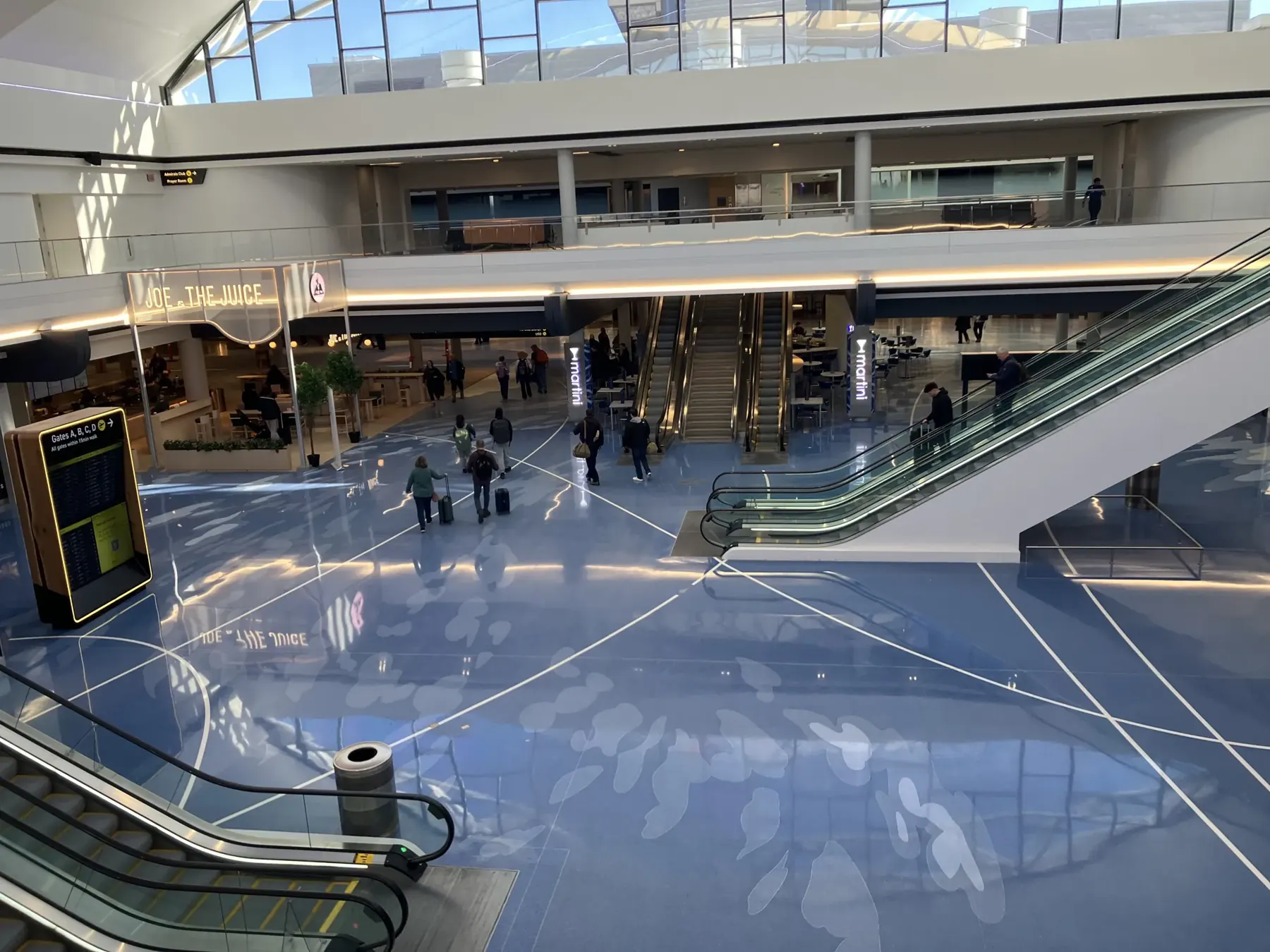
Where can I see real projects?
The projects page shows photographs of our own polished floors, as shot. Photos on the rest of the site that show Pittsburgh streets and buildings are photographs shared for reuse, credited on our photo credits page, and they aren't our jobs.
What does polished concrete cost in Pittsburgh?
The cost of polished concrete in Pittsburgh depends on the size of the floor, the condition of the slab, the finish level and the hours we can work. We don't guess a number from a distance. We walk the floor and write a scope that names each of those.
Do you also do epoxy?
Yes. The same crew does epoxy, flake and metallic systems through Pittsburgh Epoxy Flooring. If a space fits one better than the other, we say so.
Does winter change anything about how you work?
The work is indoors, so weather rarely sets the schedule. The building does need to be heated while densifiers and guards go on, and entrances are planned for salt and wet shoes from the start.
Who do I talk to?
You talk to a person: a person answers the phone, and a person reads every request. Call or use the form and ask for a walkthrough.
Your question not here?
Ask about your building. We'll answer it straight and tell you whether polishing is the right floor.